We often find 304 pretending to be 316, but now I uncover a case of 303 posing as 304.
Yeah, yeah, I know, it was twenty years ago, and we do things better now. But, if we don’t understand how such things happened, how can we be sure they won’t happen again? I suspect this one is far more systemic than the odd bar of rogue steel making its way onto the production floor.
Introduction:
I am about to point to a well-known climbing anchor product, but will refrain from naming the manufacturer, because I believe the problem is more general, and likely applies across many manufacturers. Quite simply put, it comes down to this – there is not the money in the market to support the quality system that the manufacture of safety-critical components demand. Incoming bar stock is not scrutinized, or even specified, as well as it should be.
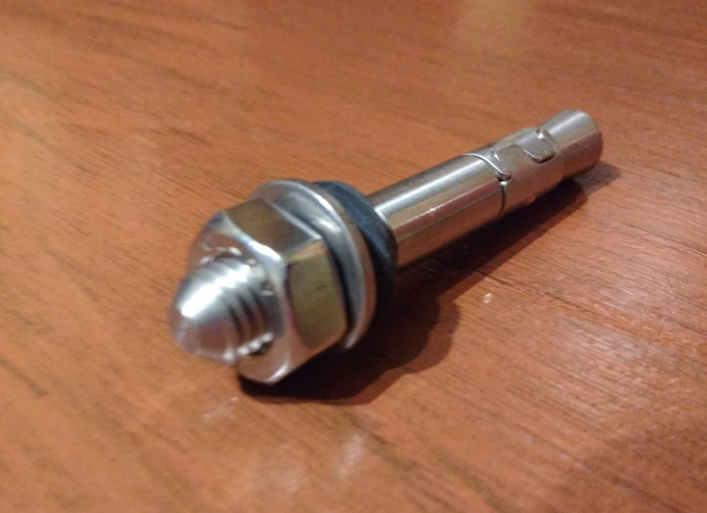
Here is an anchor of the type we will be considering.
And this is what’s left of such bolts after ten to twenty years on a sulphate cliff at Cabo da Roca.
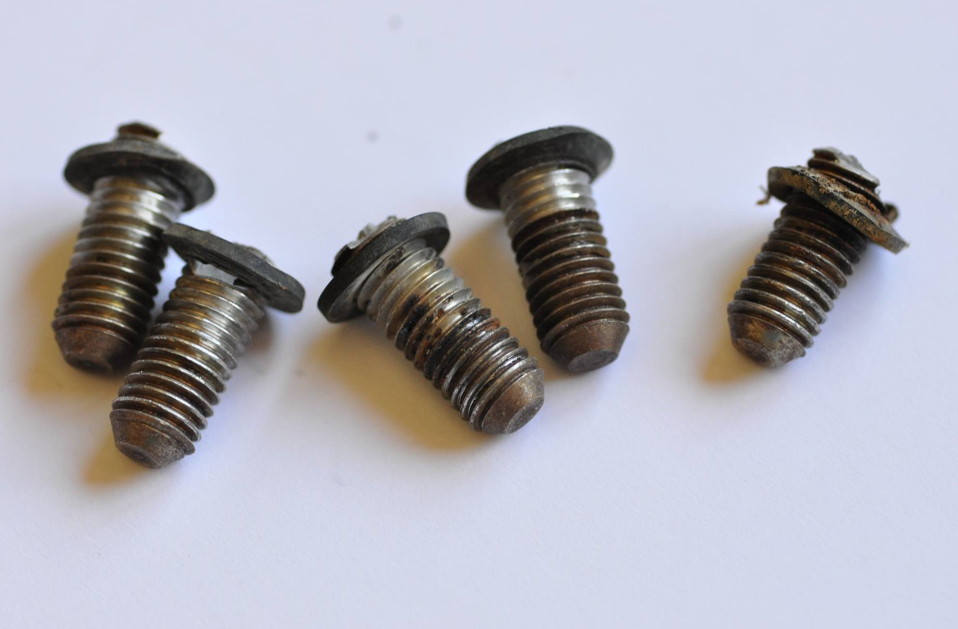
It was common practice to refer to these bolts as being 304, and I certainly did so because they analysed at 8% Ni, 18% Cr and 0% Mo.
However, the reality is that there are other 18-8 steels such as 303 which fit this description. I didn’t have the means to measure S and thus settle the matter. Now that I look back, certainly there were suspicious inclusions in some samples.
Recently we found this:
Adjacent to the Northern Queensland city of Townsville there is a granite outcrop that has been home to rock climbers for many years. Recently a climber, checking the top anchors on one of the climbs, was alarmed to have both bolts of a double bolt belay snap on being test tightened.
Both bolts were of the longer, double-wedge, version of those I illustrated above, and one is shown below. This bolt would have been installed over 20 years ago.
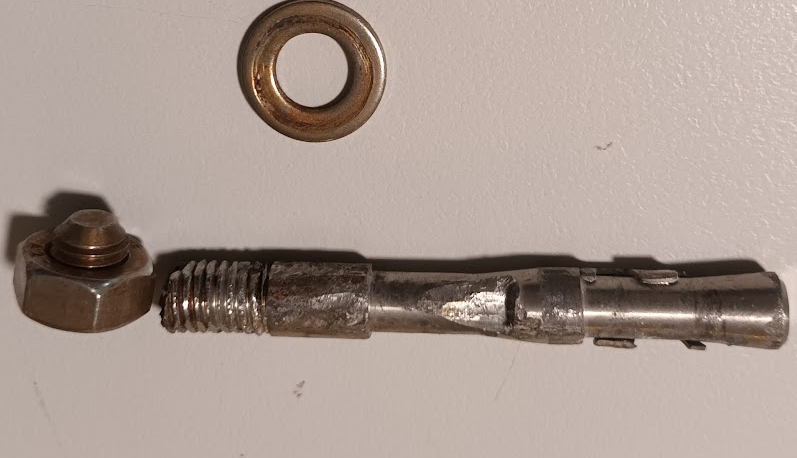
Although the fracture was readily identified as an SRB attack, I was suspicious of such a diagnosis. It seemed very unlikely given the geology and geomorphology of the location. Furthermore, both sulphate spot-testing and wall-wash analysis failed to find a sulphate source.
Now this is where things get interesting.
In the past, I’ve had reason to wonder whether a stress-crack in a sulphur-enriched alloy like 303 might, at least partially, mimic an SRB attack on 304, but have been put off by the cost of the analysis for sulphur. But now, for the very first time, thanks to contributions to our Crag Chemistry Independent Bolt Failure Testing Fund, I was in a position to send a sample away for Optical Emission Spectroscopy (OES).
And it turns out that yes, those “304” bolts are in fact not 304 but 303, showing the elevated sulphur levels of that alloy. Full report is here.
| Sample | Chromium (wt%) | Nickel (wt%) | Sulphur (wt%) |
| Stuart-1 | 17.7 | 8.5 | 0.19 |
For those readers who don’t carry stainless steel composition tables in their head, the value of 0.19% for sulphur is high compared with the upper limit for 304 of 0.03%.
Why is 303 used?
AISI 303 is a variant of AISI 304. This is an alloy where the sulphur content has been intentionally supplemented to create a population of manganese sulphide (MnS) inclusions throughout the fabric of the metal. For those production processes that involve the cutting rather than the forming of metal, these inclusions serve as chip-breakers which, by their very presence, improve the efficiency of metal removal.
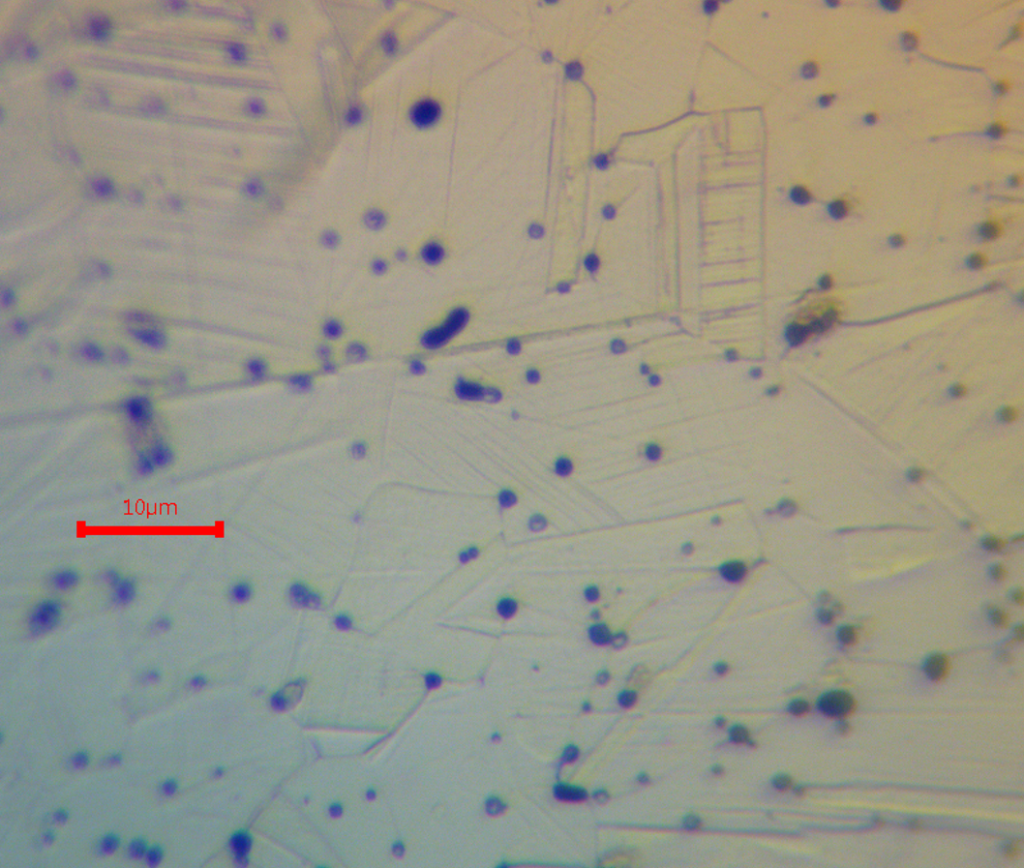
In the past I have noted that, for the bolts in question, all have cut threads, rather than the more modern rolled type. The difference is immediately obvious when viewing a polished section, as shown below.
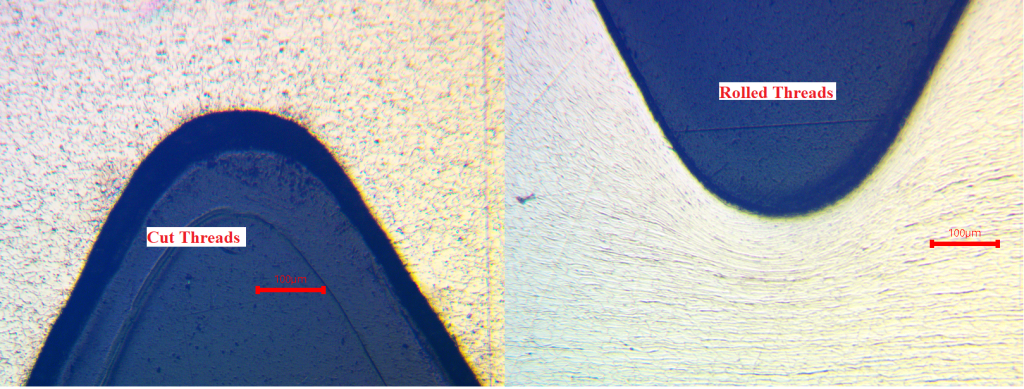
Only now does it occur to me that, for as long as manufacturers are thread forming using cutting rather than rolling processes, we can expect to find expansion bolts made of 303 rather than 304.
Sorry – no free lunch:
It’s great we can employ a myriad of MnS inclusions to reduce production effort, but unfortunately, there is a significant downside. These same inclusions, when they break the surface, compromise the passive chromium oxide film that renders stainless steel stainless. So, easier to machine for sure, but no longer truly stainless.
Every novice in the craft of engineering materials learns from his elders that there is no free lunch when it comes to austenitic stainless steels like 303 – their use has to be restricted to non-corrosive environments.
I will expand on this subject in another post. For now, I just want to cover two bullet points –
- There is much written on the pitting corrosion of these steels. It is severe. It is a showstopper.
- There is less written on stress cracking of these steels, but it is nevertheless very real. I can point to two quality studies where 303 climbing anchors have failed through SCC-like mechanisms. One of these is coastal and the other well inland .
The evidence is clear: 303 bolts should be restricted to indoor environments only.
The Euro-muddle of A2/A4:
I am as guilty of propagating muddle and confusion as the next person when it comes to slack use of these Euro categories for fasteners under EN ISO 3506. In this blog you’ll see examples of where I have written A2(304) and A4(316). This arises because it is common to say A2 when you mean 304 and vice versa.
I knew they weren’t strictly interchangeable descriptors of stainless steel, but it’s an easy 90% communication win, so I took it.
But here’s a trap! Firstly, the A2 category applies just to the finished bolt product, not the bar stock used to produce that product. Secondly, the category is very loose with respect to alloy composition, and both 303 and 304 bolt products can quite correctly be categorized as A2.
So, picture this. The manufacturer specifies 303 bar stock from his supplier because this is what his production machinery demands. He then puts the finished product in a box labeled A2. This is a perfectly accurate and legitimate product description to present to the market. The climber sees the product on the shelf and thinks, “Ah good – 304” and there you have a seamless route for getting a dangerous grade of steel onto the crag.
CorrectioN:
Thanks to reader Renato for pointing out the error. Whilst ISO 3506 places wide enough limits on Ni and Cr to allow both 303 and 304 into the A2 category, the sulphur content would force 303 down into the A1 category.
I guess I was trying too hard to be nice and find a plausible reason why 303 might accidently be marketed as 304, but that reason has just evaporated.
Conclusion:
Am I making a mighty fuss over just one bolt? I’ll let the reader judge. However, I feel obliged to sound the alarm with such evidence as I have. More will follow.
How did we come to this pass? I suspect it is because we love climbing, and we hate paying for the necessary quality, with equal vehemence. That’s surely madness? … but only to those who have never experienced the thrall of the climb.
Please Read
This post introduces a field of investigation that needs much more work. The keystone will be the OES analysis of such bolts as we encounter. For the avoidance of doubt the OES analysis has to be carried out by an accredited laboratory. This costs money.
To underpin this post we have paid AUD $385 for the one OES analysis. How we go forward from here is totally dependent on being able to pay for further analyses.
Discover more from Crag Chemistry
Subscribe to get the latest posts sent to your email.
9 replies on “Stainless steel – can we believe what it says on the label?”
Thanks for another post Dave. I’m not sure I missed something in the text. It is known that we can have SRB mediated SSC in 303 bolts because of the high level of S in the steel composition and in absence of other sulphate sources or it is still just an hypothesis? In case positive, is there a possibility that the bolt analysed by my Brazilian fellows failed because of SSC instead of SCC?
Ah! I thought this one would get your attention. 🙂 I think we are on a voyage of discovery where the more we learn, the less certain we become.
However, some ideas appear solid. Firstly, 303 is similar to 304 as far as nickel content, martensite formation during cold working, and thus vulnerability to hydrogen attack is concerned. If it turns out that many of those bolts I examined from Cabo da Roca are in fact 303, rather than 304 as I supposed, then I don’t think anything changes. As far as SRB attack is concerned, 303 is every bit as attractive as 304.
This would certainly explain why the published photomicrographs of the failure at Itatim looked so reminiscent of Cabo da Roca failures – both were H-embrittlement failure of 303.
There is no doubt that sulphide accelerates the uptake of hydrogen from a cathodic surface. That bit is solid knowledge, and thus we see SSC as a consequence of SRB attack. With no sulphate to feed the bacteria, 304 is perfectly stable.
So, the question arises does 303 seal its own fate by carrying MnS inclusions? Will it be vulnerable to SSC in quite mild conditions, and without the need for SRB attack. I can’t see why we should exclude this possibility, but my literature searches thus far fail to provide confirmation. It’s early days. We will see now that I have a source of samples.
I think MnS inclusions making the material vulnerable to SSC in mild conditions should be considered as a possibility – as far as I know there’s no sources of sulphur in Itatim, although it would be nice to confirm that.
As for 303 being considered as A2, do you have any references for that? The material I have states that A2 has a S limit of 0.03%, so it would rule 303 out. In fact, the same material mentions 303 as one example for A1 (not A2!), which does accept higher S content.
Hi Renato, so we return to the question of 303 once again 🙂
I agree with you that MnS inclusions might well increase vulnerability to SSC. I haven’t had a good look through the literature for a while, but when I last did, I found just one reference to stress cracking. Most papers were more concerned with pitting.
1. Roffey, P. Failure analysis showing the effect of sulphur content in stainless steel on the resistance to stress corrosion cracking in marine environments at ambient temperatures. International Journal of Forensic Engineering 2, 87–99 (2014).
It looks solid work to me, although, as always, I quibble with assignment to Cl-SCC when “unknown” would be better.
However, the really interesting point is they achieved failure in a 5% NaCl spray test at 38C in 14 days. Wow! That points to a threshold very much lower than 304. Unfortunately, the photomicrographs they present aren’t good enough for me to see if hydrogen embrittlement is in play.
As for your point re the S limit for A2. I think you’re correct. You forced me to dig through the internet to find a pirate copy of ISO3506 🙂 My bad for being lazy with my reference checking, but my excuse is I was thinking the best of others. Surely people would not purposely misrepresent the grade of the steel they used?
Great article Dave, as always!
The doubt about 303 was already circulating in the community 10 years ago and for sure your considerations can help understanding some strange failures that happened in not so critical circumstances like Sardinia…
Btw in my experience it is not so hard to order bars of 304, receiving them with compliance report (!) and discovering a 303 surprise just after internal testing…
Climbing is a small industry and sometimes can get some crap.
Yeah, it is hard not to feel depressed, but I think it is better to try to understand the human dimension. What can we do to change things? My guess is that education is the only way forward.
What do you have in mind with “education”? Considering the costs of the analysis, how could we help people to be confident with the material they buy – given the fact that the topic is complex even for experts?
Education, as in what simple tests can the route equipper use? This is a subject I’ve put a bit of time into whenever I can. My initial target was the 304/316 distinction. As far as SRB was concerned, and lets’ face it, it was the primary concern for many years, then the question to be answered from the field was not 304 vs 316 so much as percentage martensite formation following cold working. Thus, a magnet test was all that is required. A commercial Mo spot test is probably not that useful.
There is a great irony in the fact that when we finally encounter stress-cracking of true, verifiable 316, we find that SRB attack is not the cause. Those anchors from St Savvas were most certainly not magnetic and would have passed the magnet test.
So, getting the composition right is only part of game. We now need a simple spot test for overwrought formed-threads. If I’m right in my supposition as of what went wrong with the Petzl Goujon of that vintage, and bear in mind I have a heap more testing yet to do, then it is not the thread rolling per se so much as the electrochemical changes that occur at the thread root. If this is so, then I have in mind a simple spot test for this. Time will tell.
And, as if those goal posts aren’t moving quite enough, it now looks like the use of 303 as substitute for 304 is far more widespread than I ever imagined. No wonder we have anecdotal accounts in conflict with one another. On this one I can bring some relief. There is an old test for 303 using photographic printing paper. It’s a nice simple test that I haven’t taken seriously because I wasn’t able to authenticate my results, and anyway, surely no one would put 303 on a crag 🙁
I’ll get organized and post up a method, that should serve to warn against this dangerous alloy creeping into climbing anchor supply.
Lovely! These are great news indeed. There’s not just the material science layer, but also the communication to non-experts that increase the challenge even further. What you are referring to could really support people outside struggling with the material choice.