Sulphide Stress Cracking (SSC)
The second part of a multi-part series
For SCC see Part 1
TL;DR
- High levels of calcium sulphate provides food for sulphate reducing bacteria (SRB)
- A unique SRB forms a consortium with a putative iron oxidising bacteria (IOB), to create a sulphide-rich, acidic and anoxic environment in direct contact with bare metal.
- Cathodic charging of the metal with atomic hydrogen is thus inevitable.
- Over a number of years, atomic hydrogen will diffuse as much as one centimetre leading to wide spread hydrogen embrittlement.
- Internal stresses within the metal part cause the embrittled metal to crack – sulphide stress cracking (SSC).
- The cracking provides further access for the SRB deep into the bolt.

Tonsai/Railay is where stainless-steel anchors go to die. We can now add, that the cause is SRB-mediated SSC.
Introduction:
I owe much to Martin Roberts of Titan Climbing for taking the initial steps of our great adventure into crag chemistry. Without those first steps in late 2016 we all would still be wondering, wistfully, about what might or might not be happening to bolts on the crags of Railay/Tonsai.
Armed with an aquarium test kit or two, and some pH papers, Martin set about measuring stuff, and it soon became obvious that things were very different to that anticipated. With the enthusiastic support of Alan Jarvis from UIAA Safe Com, I was able to get serious with the analytical chemistry, and quickly discovered the presence of high levels of calcium sulphate coating the surface of the rocks themselves.
We also were able to demonstrate anomalous pH values at the point of corrosion, and, in addition, were able to point to the presence of sulphide. These findings alerted me to the possibility that sulphur bacteria might be involved, although, at that time, I couldn’t see such involvement being significant. I guess I was pretty naïve about the chaos SSC could cause. After all, everyone’s focus was firmly on the villain du jour of stress corrosion cracking (SCC).
This is what I think is happening:
I am going to start by outlining my current understanding of the mechanism of attack. I intend to do this in as simple a manner as possible; just complex enough that we can shift from magical to logical thinking.
And yes, I’m fully expecting the skeptical reader to start wondering what planet I’m on, and so, getting my defense ready, I’ll draw the attention of those of you who have the stomach for such things to the detailed arguments and literature references in two of my Cabo da Roca posts.
- For sulphate reducing bacteria (SRB) and its electrochemical environment look here.
- For hydrogen embrittlement look here.
Sulphate reducing bacteria – the SRB must-haves:
If you want to invite SRB to your party, then two conditions have to be met or they simply won’t turn up – part measures will not do. For that truly bolt-snapping event, there needs to be available, a) an anoxic microenvironment sufficient to host the little guys, and b) an excess of sulphate to feed them.
Anoxic microenvironment:
SRB are what we call obligate anaerobes. This means they do not switch-on their metal burning metabolism until the ambient oxygen level falls well below that of the atmosphere. This is because they have evolved to use sulphate whereas all other self-respecting microbes use oxygen.
Given that a bacterial cell can be as small as 1/1000th of a millimetre, then it is clear that a miniscule microenvironment will suffice for their needs. In reality, most types of bolts provide plenty of nooks and crannies where SRB can take up residence.
Let’s look at the expansion bolt / fixed hanger combination illustrated below. Check out the spacious anoxic zone located just a few millimetres below the surface.
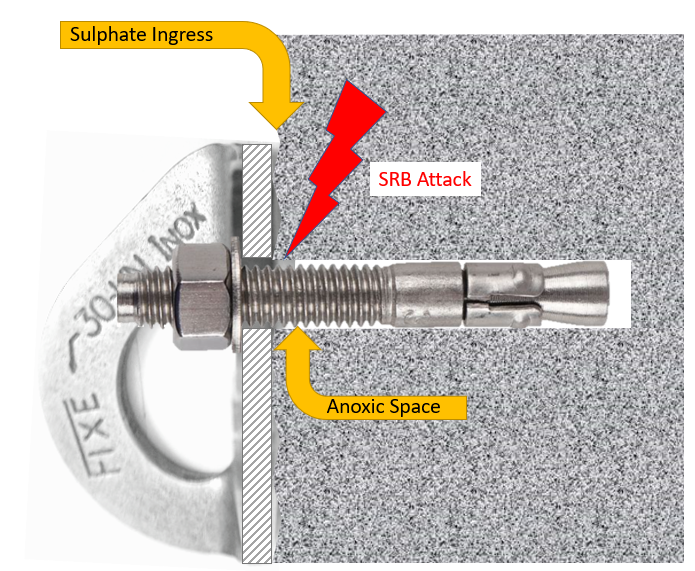
If you wanted to encourage SRB, then surely, this must be the best way to do it, and, not surprisingly, we see expansion bolts fail through hydrogen embrittlement (HE) and ultimately, SSC, at this point.
Note that such attack is hidden from view, and the shaft of the bolt can be dangerously weakened by embrittlement long before the attack becomes obvious. Fortunately, we often get some warning of impending doom because the bacteria will also attack at the anoxic space between washer and hanger, nut and washer etc. In such cases the “black ring of death” often appears as a warning. More on the “black ring of death” later.
At first sight, you’d think a glue-in bolt would offer less anoxic spaces than a mechanical bolt assembly, but no, experience shows them to be every bit as inviting to SRB. If we look at the glue-in twistie illustrated below, the points of attack can be seen.
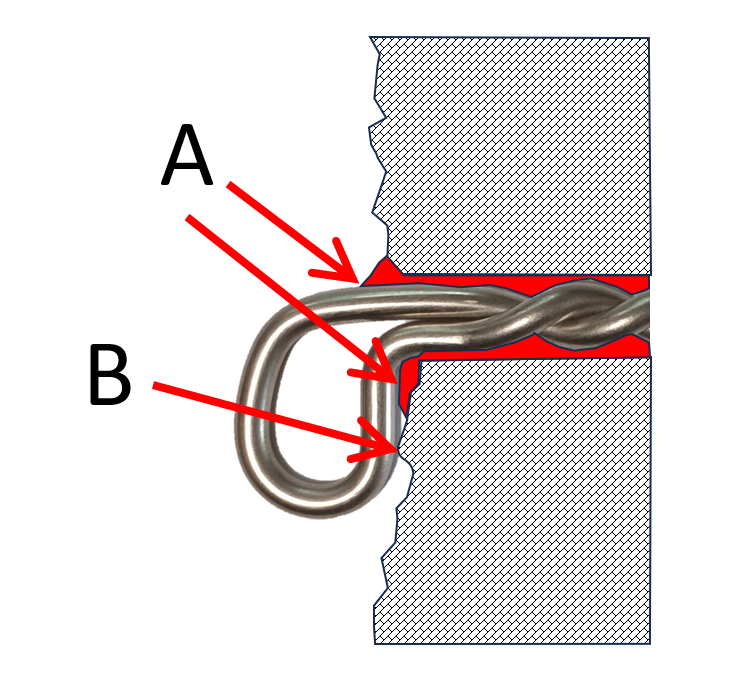
The points labelled A are always vulnerable. You might assume that, given the fact that the glue wets the metal surface, there could be no space for the entry of SRB. In practice, it doesn’t take long before a crack opens between glue and metal. This is logical considering that metal-to-metal, and glue-to-glue, cohesion is greater than that of the glue-to-metal bond. Given the difference in the coefficients of thermal expansion of metal and glue, the opening of a space at this point is inevitable.
The anoxic point labelled B, where metal contacts the rock, is also a frequent point of attack for glue-in bolts.
Excess of sulphate:
It is certainly true that, for most bolts, adequate anoxic spaces exist to support SRB attack, yet, despite this availability, the fact remains that for very many locations across the world, evidence of SRB attack is completely lacking. So what are we missing?
All the evidence I have accumulated to date indicates that SRB attack will occur only in the presence of high levels of sulphate. How, high? The short answer is very high. High enough for it to be visible here and there as efflorescent and crystalline deposits.
When we take spot samples at Railay/Tonsai we find levels of calcium sulphate that are quite remarkable. I cannot emphasize sufficiently just how different this is compared with any other sea-cliff. Provided you are no more than a few tens of metres from the hightide mark, the presence of sulphate is unmistakable.
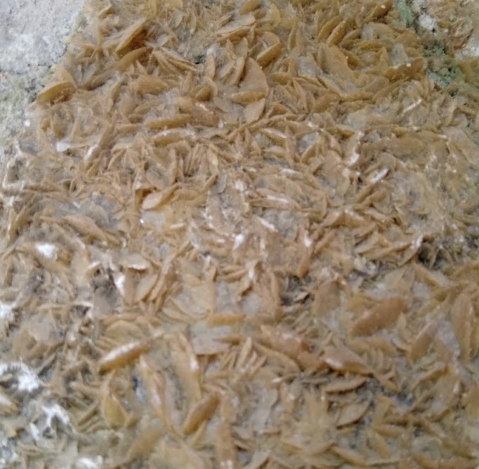
Water saturated with calcium sulphate runs down the rock surface in sufficient quantities that in some locations it can form rather perfect crystals, as shown below.
However, we shouldn’t jump to the obvious conclusion that the limestone must contain sulphate. The very fact that sulphate is observed only for those crags on the immediate waterfront is sufficient to falsify such notions.
And just for those readers who can’t let go of the idea that the sulphate is somehow endogenous, not exogenous, here is an analysis I made of an actual rock sample.
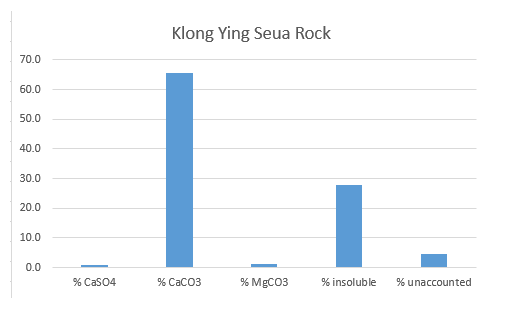
The rock type is metamorphic limestone/marble, and we can see it is approximately 70% calcium carbonate and 30% acid-insoluble material, presumably siliceous stuff. Note that both gypsum (sulphate) and dolomite (magnesium) components are very minor.
The critical must-have for SRB attack is large quantities of sulphate, and, this we have at Tonsai/Railay, but at no other Thailand crag. See Part 1 of this series for geochemical data on the other crags.
Quite why we see sulphate only for those crags immediately on certain sea fronts is something I’ll leave for the next part in this series.
This is how SRB work their destruction:
What I’m about to describe may seem strange, but, it is nonetheless chemically correct: just as we humans derive our energy by burning carbohydrate in atmospheric oxygen to yield carbon dioxide, SRB obtain their energy by burning metallic iron in the presence of sulphate to yield iron sulphide. It’s useful to keep this analogy in mind because we are dealing with a living entity here.
Of course, I’m not implying that we will see flames of combustion. Respiratory processes just aren’t that rapid, but rather, the process is analogous to the slow ‘burning’ of iron that occurs when it rusts. From a chemical point of view, the key mechanism is the extraction of electrons to release metal ions into solution. The metal is consumed.
So far so good, after all, this is no more than good old-fashioned rusting; throw a steel nail onto waste ground, and we know what is going to happen. However, once SRB are involved, things get a lot more complicated.
Direct, electrically-coupled, anodic process:
These little guys are exceedingly proactive in their destruction of steel. They have microstructural features that allow them to electrically connect to the metal surface. It is the biological equivalent of attaching the positive terminal of a battery directly to the metal of your climbing bolt to render it anodic. See ref. for an elaboration.
Sherar et al published this nice pic of SRB connected up to an iron surface. Those threads are an electrically conductive cellular components that channel electrons from the metallic surface into the cytoplasm of the organism.

Lets take a quick look at the chemistry. There are some unique things going on here that make it very different to your usual rusting bolt.
In the diagram below I have illustrated the anodic process whereby a bacterial cell is electrically connected to the metal surface. Within the cytoplasm of the bacterium, electrons are consumed by an enzymatic process that reduces sulphate to sulphide, and in so doing induces a flow of electrons from the metal along the connective pili. Ultimately, iron atoms, deprived of two electrons each, are released as ferrous ions into solution.
Note two things, a) metal is removed, and b), the point of removal need not be adjacent to the bacterial cell, because electrons are freely conducted within the metal.

Hydrogen embrittling cathodic process:
I have also illustrated a possible cathodic process whereby hydrogen ions in solution accept an electron from the metal surface. Following on such an event, hydrogen atoms will accumulate until catalysis at the surface sponsors recombination and the release of hydrogen gas.
There is nothing especially unusual about what is happening here, until we factor in the presence of SRB. Under such circumstances, it is inevitable that the microenvironment will become rich in sulphide, and just as inevitably, the catalytic recombination of atomic hydrogen will be ‘poisoned’, resulting in a marked accumulation of atomic hydrogen at the surface. Given it has nowhere else to go, atomic hydrogen diffuses into the solid metal.
Cathodic hydrogen charging brings with it the risk of severe embrittlement. This is particularly so for the stainless steel alloys such 304 where cold-working partially transforms the original austenite to alpha-martensite. Such is unfortunate because, whilst austenite is relatively impervious to hydrogen embrittlement by virtue of its resistance to atomic hydrogen diffusion, the same cannot be said for martensite, which exhibits a hydrogen diffusion rate as much as 1000-times higher. Under these circumstances, the migration of hydrogen over significant distances can occur, leading firstly to embrittlement, and then stress-cracking. Thus, it is inevitable that stress-cracks will be propagated conformably with the stress fields that remain following cold-working of the part. It is this sulphide stress cracking (SSC) that really defines the destructive nature of SRB attack.
This is all very bizarre, but we’re not done yet. I promise you that it gets stranger!
Anomalous acidic environment:
SRB metabolism, by its very nature, creates alkaline environments. For example, when an iron pipe is buried in swampy ground where sulphur bacteria are active, it is typical for a thick layer of iron sulphide and iron carbonate to build-up over the bare metal. The following stoichiometry is representative of what is happening, and we can infer that the pH is likely to be in the range 8 to 9.
{\scriptsize 4Fe^0 + SO_4^{2-} + 3HCO_3^- + 5H^+ \longrightarrow FeS + 3FeCO_3 + 4H_2O}The photo below shows typical SRB attack on a steel sample buried in mud of the North Sea.

A thick, amorphous coating comprised of mackinawite (FeS) and siderite (FeCO3) builds up as corrosion proceeds, thereby significantly reducing the corrosion rate.
However, what we are seeing with climbing bolts is nothing like this. We find that the pH of the environment is always between 2 and 4. Clearly this is an acidophilic SRB, perhaps similar to those found inhabiting acid mine drainage. See ref. for a review.
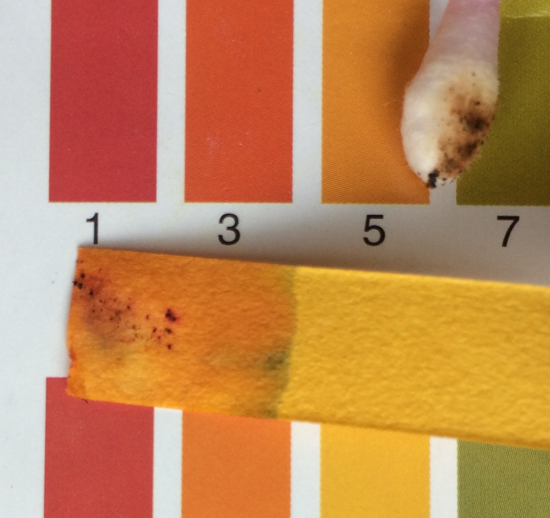
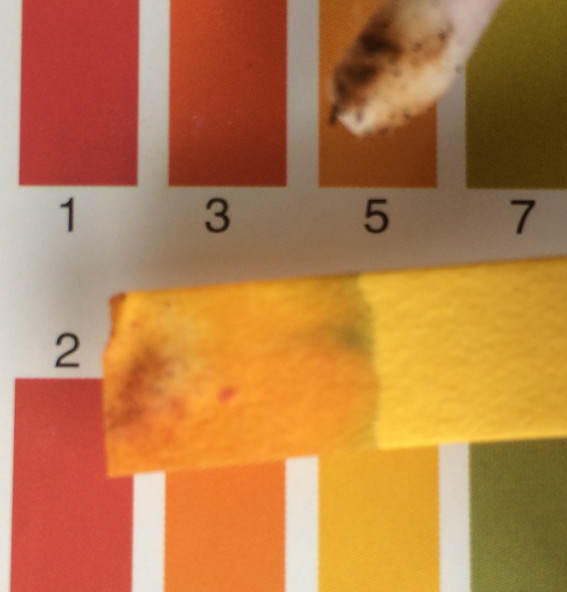
Rather than try and understand how this can possibly occur, for now, let’s roll with the evidence and see what the acid environment means for the electrochemistry.
The Pourbaix diagram for the iron sulphide system is shown below.

From this diagram we can see that, under anoxic conditions, if the pH is maintained at a value less than say 4, precipitation of sulphide is forbidden. Thus, unlike the common alkaline SRB environment discussed above, we’d predict the metal surface would remain bare and uncoated. And this is exactly what is observed when we take a section through the corroded part of the bolt, as illustrated in the photo below.
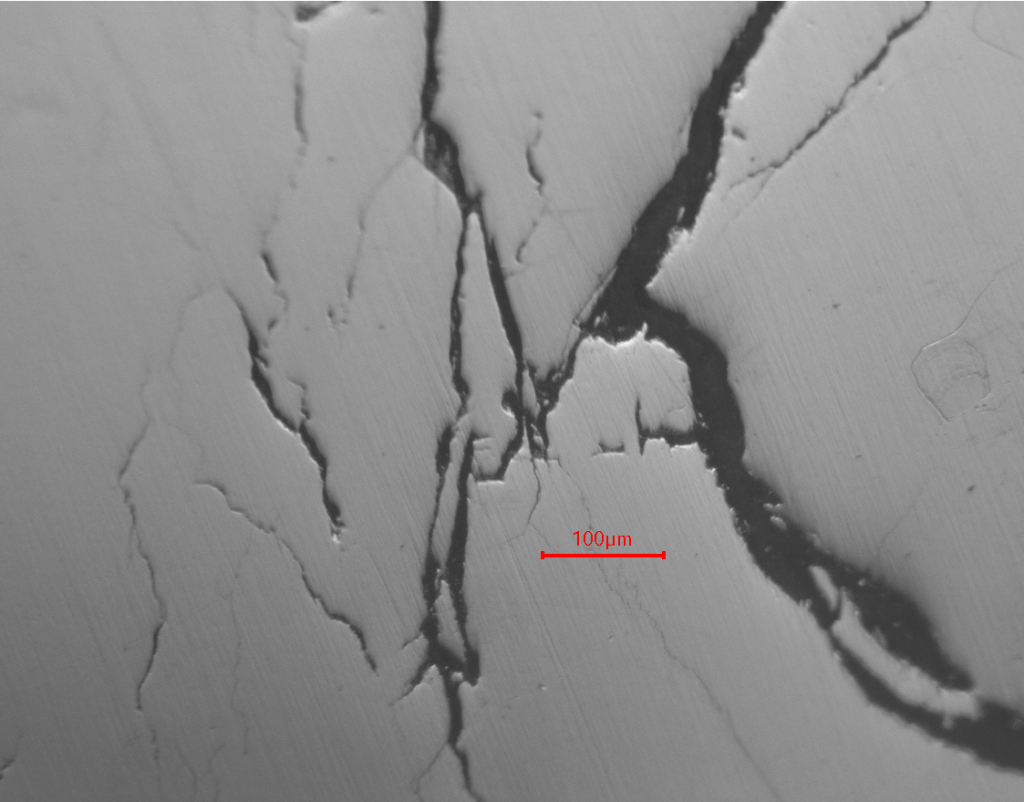
In addition, although perhaps it is less than obvious, is the fact that, should sulphide precipitation be suppressed, ionic sulphide and hydrogen sulphide will remain in solution at relatively high concentrations.
Thus, not only will the bare metal be exposed to an acidic environment, but also one rich in sulphide, and given that the electrochemistry is sufficiently cathodic, as indicated by the red line in the Pourbaix diagram, hydrogen ions in solution will begin to pickup electrons from the metal surface to form atomic hydrogen. Thus cathodic charging of the metal with atomic hydrogen is inevitable… now, we are really in trouble!
A further consequence of the acidic environment is that, should the oxygen level rise at points close to the surface, the Pourbaix diagram predicts greigite would be deposited rather than mackinawite. And this is exactly what we see happening. The precipitation of the distinctive, iridescent, octahedral crystals of greigite is a frequent feature of the SRB attack observed on climbing anchors.
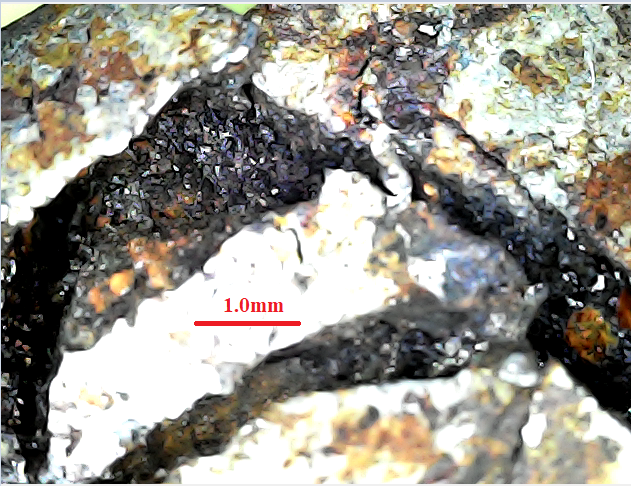
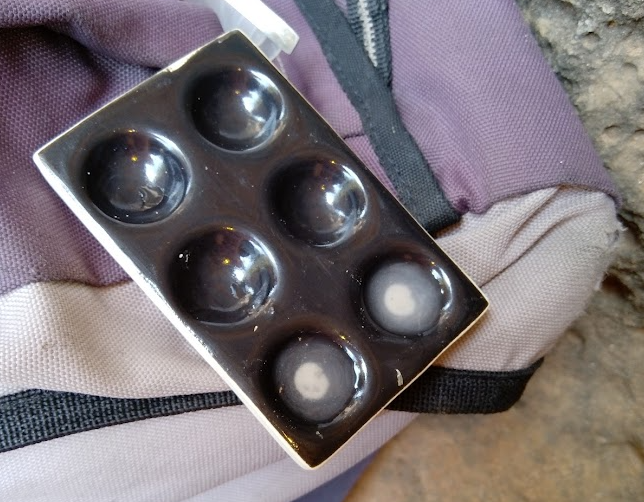
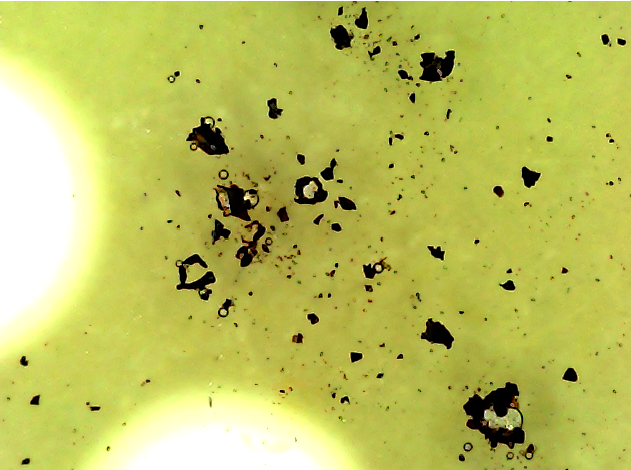
If we scrape such a deposit onto a microscope slide, and then add Iodine-Azide reagent, the release of nitrogen bubbles confirms we are indeed looking at a metal sulphide.
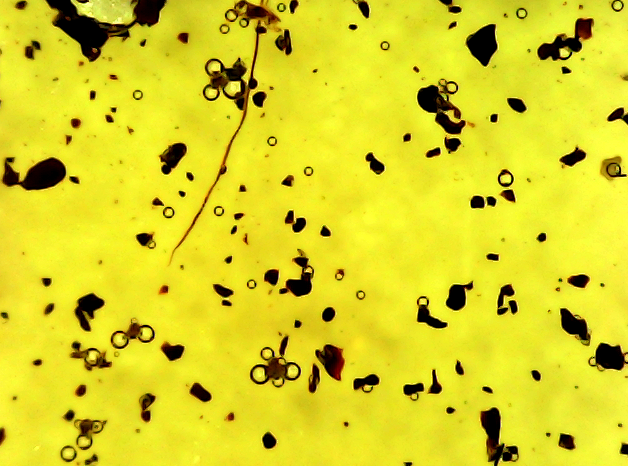
It is my contention that if we encounter a case of stress-cracking, then the following observables are sufficient for us to attribute it to SRB mediated SSC.
- active sites of corrosion have pH < 4.0
- clusters of greigite crystals
- positive response of Iodine-Azide reagent
Of course, there are some distinct observations of micro-structure we could make to confirm hydrogen embrittlement, and we will come to them soon.
SRB don’t act alone, but in consort with Iron Oxidising Bacteria (IOB):
I fully understand folks thinking that things can’t get any weirder, but alas, we are not yet done! We now have to consider the fact that sulphur bacteria are well known to form redox-cycling consortia with other species such as the iron bacteria. See the review at ref. for an introduction to the acidophilic SRB, and their association with other bacterial groupings.
Enter the “black ring of death” (BRD). Not only is it the harbinger of that rapid descent to ground we’d all like to avoid, but, as a putative SRB-IOB consort, it also provides us with an explanation for the problem we have with the stoichiometry of SRB chemistry, viz. why are we seeing an acid environment when the conversion of sulphate to sulphide should promote the very opposite?
The picture below is a typical presentation of the BRD. This fixed hanger is 304 and had been installed at the UIAA Test Site at Heuco Wall for over seven years when the photograph was taken.
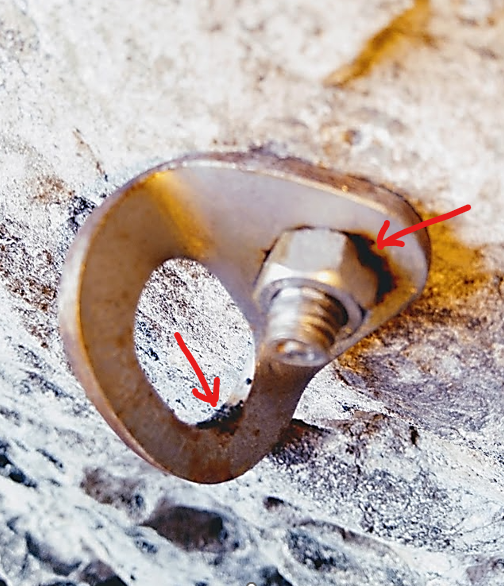
The right-hand arrow points to a dark brown/black deposit coating the anoxic space between nut and fixed hanger. Warnings don’t come clearer than this – Back off! SRB at work!
The left-hand arrow points to something I believe to be a Tonsai/Railay special. Here it would appear that a tiny anoxic flaw in the metal surface has provided sufficient foothold for SRB to initiate attack. As the attack proceeds, an SRB-IOB consortium is established which provides isolation from the atmosphere by the development of a protective “igloo”. Such structures are uncommon on other sulphate cliffs, but maybe the environmental conditions (humidity?) are more favourable at Tonsai/Railay?
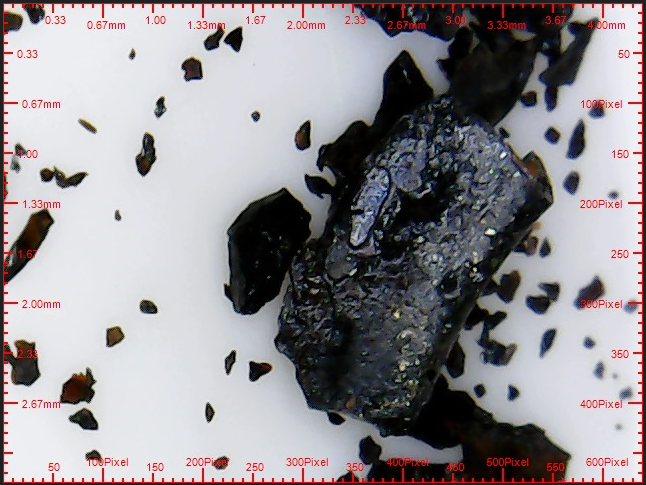
Let’s take a closer look at this coating. Using a hard steel point, or fine file, it is easily removed from the metal surface. Examination under the microscope shows it to be a brittle, glassy solid that readily shatters. It forms a continuous barrier at the interface between the anoxic SRB environment and the atmosphere.
We have already described how we can pick up a small fragment from beneath the BRD only to reveal a very acidic environment. But what I haven’t yet mentioned is how the surface just outside, immediately adjacent to the BRD, is strongly alkaline. The physical distance separating acidic from alkaline zones is less than 1mm.
The photo below is a bolt inside the big cave, Lhak Chui, at Phra Nang. I chipped off the BRD at a couple of points and pressed pH paper to the surface. Note the pattern, very acid inside, very alkaline outside.

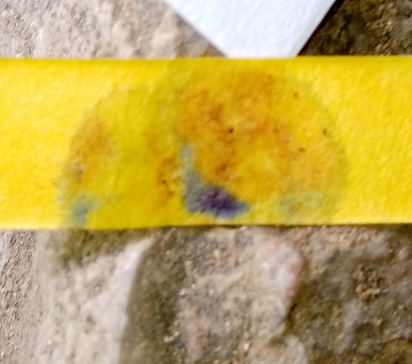
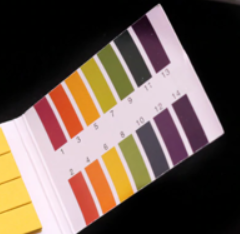
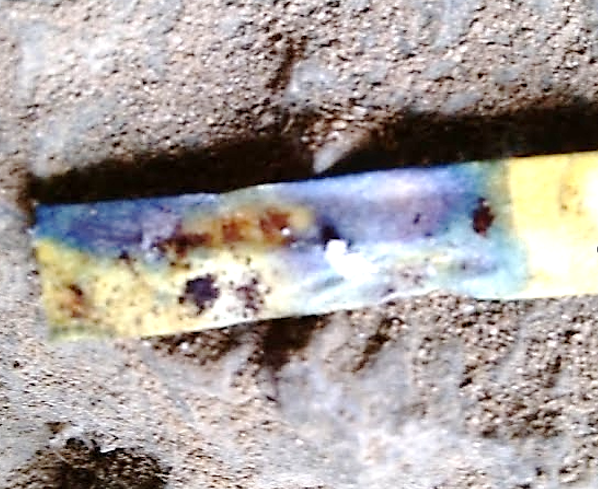
The fact that the system is capable of developing and maintaining such a steep pH gradient surely indicates active ion transport across a physical barrier. My current hypothesis is that the BRD is a barrier biofilm established by an iron oxidising bacterium (IOB). This species can accelerate the normally slow oxidation of the ferrous to the ferric state, extracting metabolic energy from the process as it does so.
{\scriptsize 4Fe^{2+} + O_2 + 10H_2O \longrightarrow 4Fe(OH)_3 + 8H^+~~~~~}Notice that in carrying out this oxidation, IOB are working in the opposite direction to SRB, in that they are acidifying the environment as they proceed.
They also fix carbon from carbon dioxide to sustain cellular growth, and, significantly from the point of view of biofilm formation, exude part of the acquired carbon as a structural exopolysaccharide.
The diagram below illustrates a possible way in which SRB could work with IOB to provide the acidic, sulphide rich environment we observe.
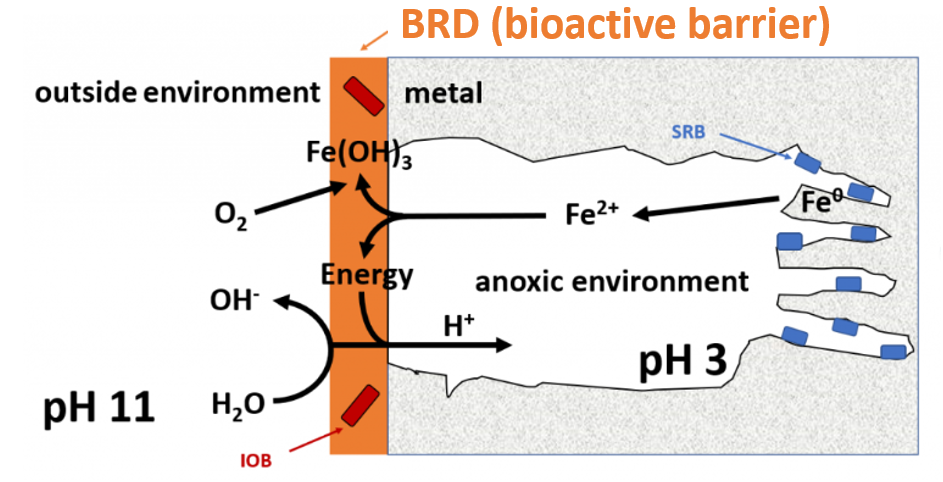
So we finally arrive at the last part of this story. With bare metal in contact with a sulphide-rich, anoxic and acidic environment the stage is set for the highly destructive hydrogen embrittlement and stress cracking that follows.
Hydrogen embrittlement and stress cracking – this is where the real damage is done:
So this is where we see metal turned to dust. Dust? Surely not! Well OK, give me another name for micron sized fragments! There should be no doubting the fact that a tough, ductile metal can be transformed in such a way that it is tough and ductile no longer. It might still look the same, and really it is the same, except for its tensile properties. Ductile has become brittle.
I am suggesting that we are observing a form of hydrogen embrittlement known by the acronym, HELP. It is so called because help is exactly what one needs to make any sense of what is going on! However, jokes apart, the letters stands for Hydrogen Enhanced Local Plasticity, but, let’s not worry about that, and instead, concentrate on the damage that results… for the determined geek, I attempt an explanation here.
Illustrated below is at typical example of what happens to any 304 glue-in bolt unfortunate enough to be installed on a Railay/Tonsai wall. SRB attack has commenced at the anoxic zone of the glue line, and, over time, hydrogen has diffused within each leg to the extent that stress cracking dominates the 10mm or so of metal immediately adjacent to the glue-in point.
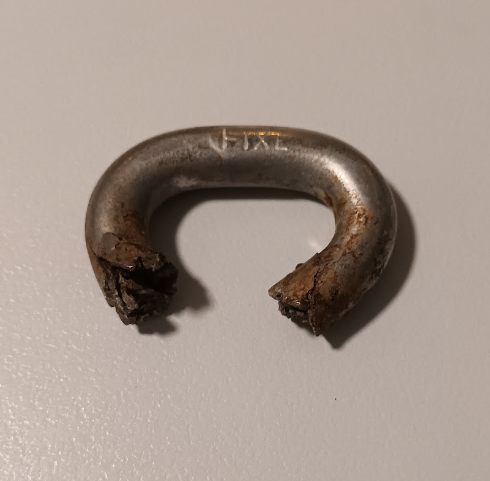
If we look at the left hand fracture surface in the picture below we see that, at final failure, this bolt was holding by little more than a few points of solid metal – indicated by the arrows. These points being embrittled, would hold very little.
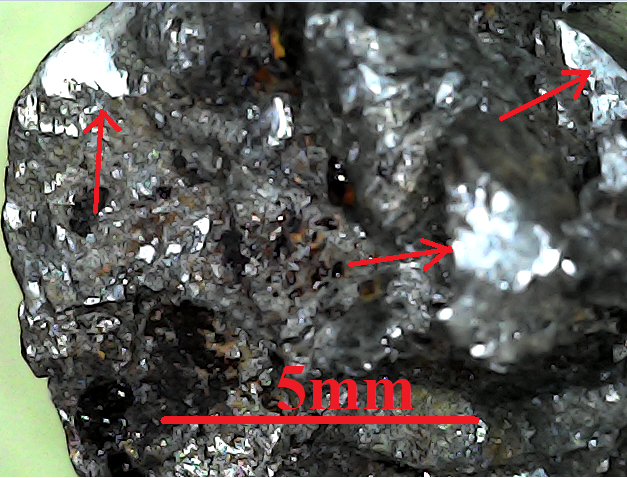
Notice also the thin coating of corrosion products on what would have been the inner surface of stress cracks. The greenish-grey appearance of so-called ‘green rust’ is worthy of note. The latter is a known feature of sulphate-containing, anaerobic environments, see ref. . Also visible are regions of tunneling into the walls of the crack, which I attribute to remove of metal by the anodic component of SRB attack.
In the picture below we see greigite deposits where a solution tunnel from the outside has been intersected by a plane of brittle facture.
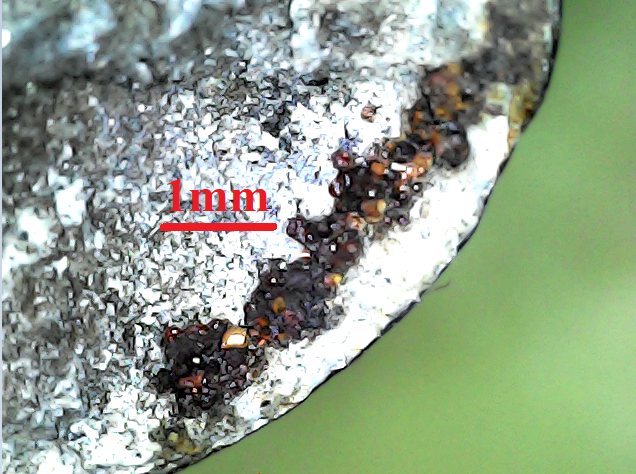
And just for completeness, let’s just confirm that we indeed are looking a a metal sulphide by testing a scraping with Iodine-Azide reagent.
If we polish a section, taken longitudinally from the end, the true magnitude of the cracking process is revealed. The two photographs below shows the 3mm or so closest to the glue-in point. The fracture surface is on the right.
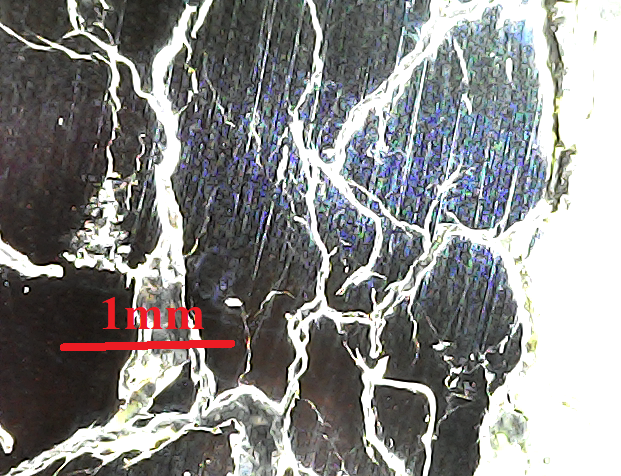
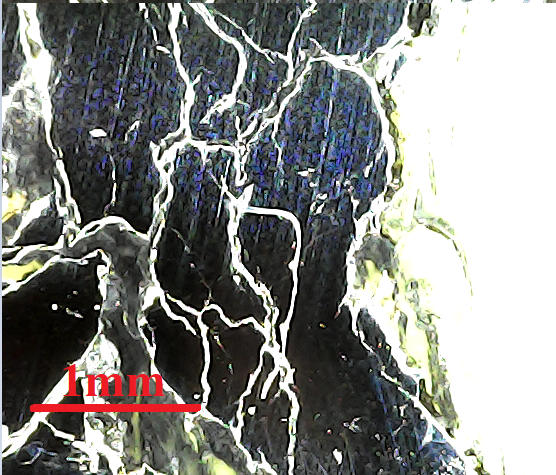
The bare metal shows as black with the open cracks in white. In places it is possible to see down through the transparent epoxy resin encapsulant – the straw yellow colored sections.
Looking wider, we can see that fractures extend well along the length of the bolt.
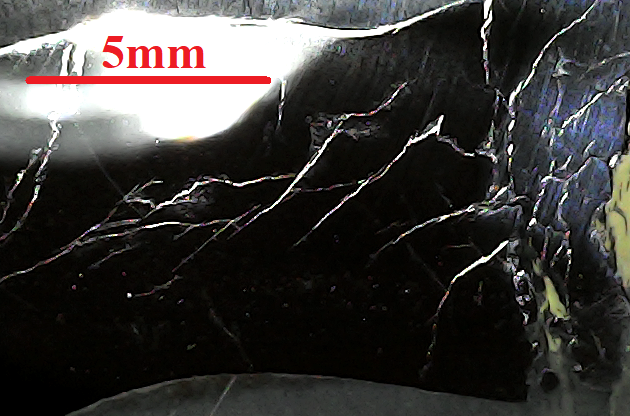
The video below takes a quick trip along the final 10mm length, and back. Perhaps the take-home message is that serious hydrogen damage extends well beyond the point of attack and into apparently good metal.
In the photograph below, we take a closer look at the same polished section. Note that stress fractures occur at all scales down to the micron level.
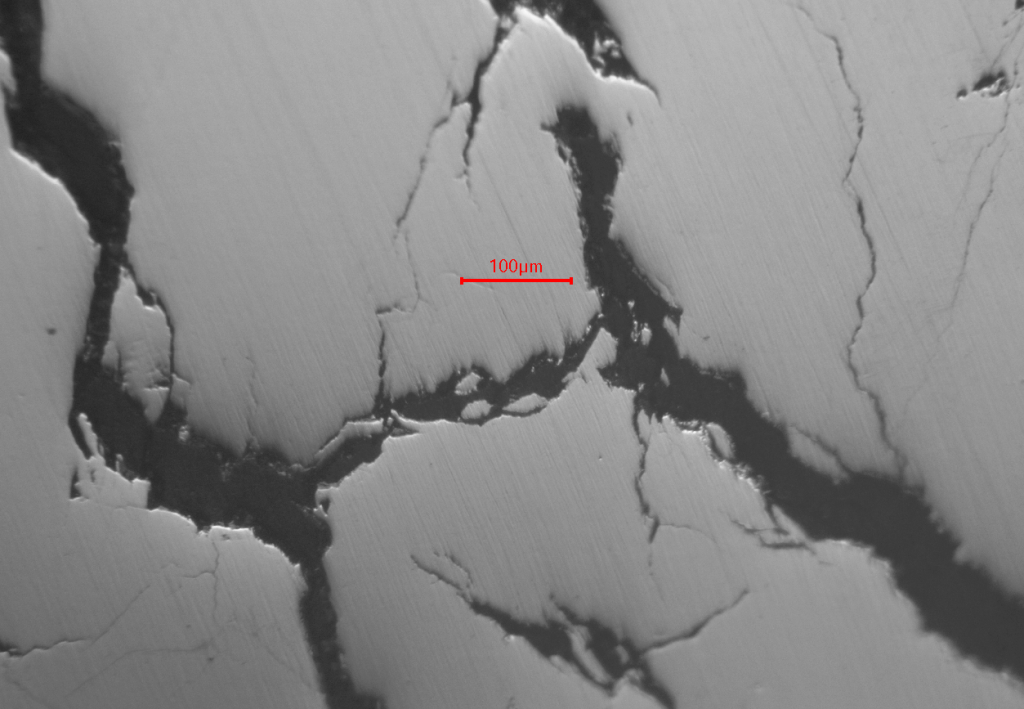
Of particular interest are the edges of the wider cracks, and the way that the bulk metal appear friable, with the fracture leaving behind a detritus of small metal fragments. Yet we know that this metal was once tough and cold-formable, whatever happened? It seems reasonable to conclude that all of the bulk metal pictured here is in fact embrittled.
If we zoom in even closer, it is easy to capture images that hint at an ultimate fracture dimension of approximately 1um.
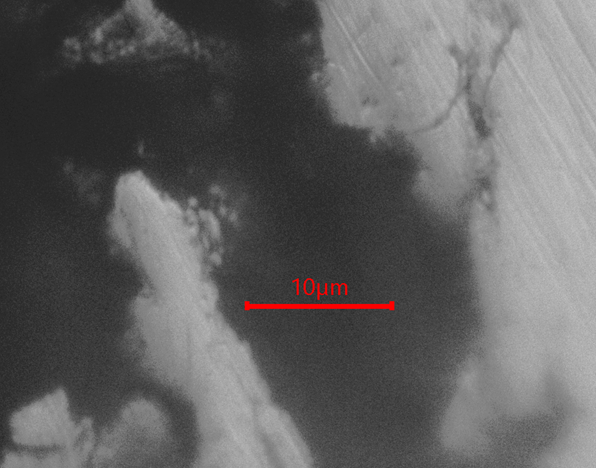
Observations from other SRB bolt failures in the Mediterranean and Portugal accord with this lower fragment size of approx. 1um. I will go on to argue that this fragmentation down to the lower micron size is an indicator of the HELP mechanism in play.
But first, let’s take a look at the same surface when it has been electrolytically etched with nitric acid. This treatment highlights microstructural features such as slip bands, twin boundaries and grain boundaries.
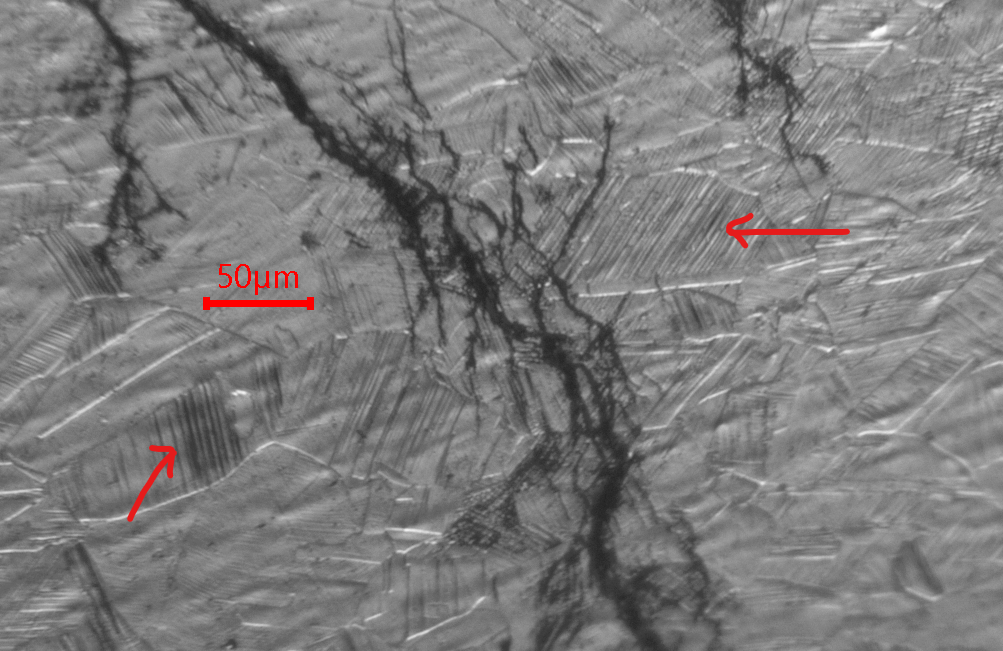
The extensive plastic deformation this part has undergone during manufacture is evidenced by the proliferation of slip bands. I’ve marked some of the prominent examples in red. Notice that the spacing of slip bands one to another tends to be uniform.
Slip bands represent points at which dislocations in the lattice have piled up during plastic flow, they are not microcracks. However, microcracks can be seen propagating from the larger crack traversing the image. At some points these true cracks seem to be conforming to the lattice orientation revealed by the slip bands. In other cases not.
If we look at the non-etched view of the same section shown in the photo below, a crack can be seen traversing what looks like an array of micro-voids. Note the regular spacing of 1 – 2 um. This is of similar scale to both the inter-slip-band distance and the minimum fragment dimension we observed above.
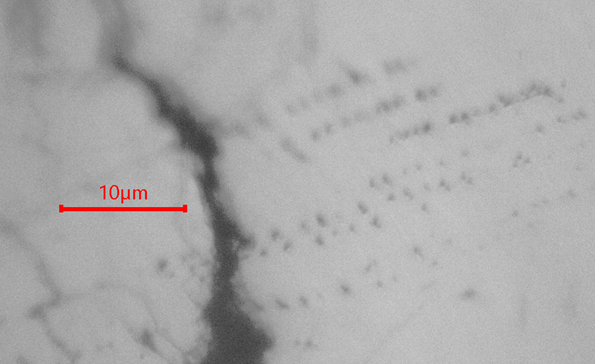
I have observed this phenomenon in other examples of hydrogen-embrittled, heavily cold-worked 304 bolts from Portugal, and consider it to be evidence for the HELP hypothesis.
When a set of slip bands are intercepted by a planar obstacle, such as another slip band, then hydrogen induced plasticity can result in high local stresses, sufficient to break metallic bonds and initiate microvoid formation.
provide the following illustration.

Note that the sites of crack formation are only indirectly modulated by the slip bands themselves. It is at the intersection of two glide planes, where the interaction between the slip bands they carry can drive local stresses high enough for micro-void formation. However the spacing of such voids and their preferred direction of coalescence will modulated by the characteristic inter-band spacing we observe. Thus we can expect to see fracture particles no less than 1 to 2um in dimension.
Whilst it is clear that SRB can “drill” solution tunnels into solid metal by virtue of its anodic process, it is debatable just how fast such a process could progress in the absence of stress cracks forming. The rate of diffusion of atomic hydrogen through the bulk metal must play a significant role in the rate of this corrosion process.
Knowing what we now know, what can be done?
It is abundantly clear that if we choose an anchor material that resists hydrogen embrittlement, then we will be much further forward. So let’s start with the options for stainless steel.
HE resistance of stainless steels:
It has been long understood that austenitic steels owe their hydrogen resistance to the lower rates of diffusion of atomic hydrogen through the face centered cubic (fcc) lattice of the austenitic allotrope. By comparison, rates of diffusion through the body centred cubic (bcc) lattice of ferritic alloys is as much as x1000 greater. Thus, for many years. the austenitic stainless steels have been the alloy of choice for hydrogen service.
And 304 is an austenitic steel, right? It should be good for purpose? Well no. Sure it is an austenitic steel, but a metastable one, that readily rearranges to the more stable bcc form of martensite. The reality of the situation is that most, if not all, 304 cold-formed product is at least partially martensitic, and is therefore open to attack by hydrogen.
I discuss this thermodynamic instability and its implications in this post. The austenitic stability swings critically with the nickel content, and even as much as forty years ago, it was known that reducing the nickel content below 10% brought a world of pain.

Notice how sharp the 10% cut-off is. At 8% nickel, it is clear that 304 is going to be a problem, and, indeed, we should not be surprised at the dismal failure of this particular alloy to withstand SRB attack.
But what of 316 which boasts over 10% nickel? And what of the additional 2% of molybdenum that will boost austenite stability? Can we assume it might well cross the line of acceptability? I would be more relaxed about this proposition if it wasn’t for the terrible reputation of the stainless steel industry to manufacture to specification. Nickel is an expensive component and manufacturers have an incentive to be frugal with it. More often than not, when I analyse anchors claimed to be 316, the nickel content is below the magic 10%. Look at that curve. Can you see why 9% is not “sort of 10%”?
I have spent quite a number of years trying to find an example of 316 that has succumbed to SRB attack. Yes, I find plenty of material that is claimed to be 316, but is substandard – shame on all of you manufacturers for such omissions of quality control. But I am yet to find a failure of true 316. Maybe 316 is actually ok?… yeah, nah…. how would we know if so little true 316 has actually been installed?
What about titanium?
Let’s open with two contra-indicative facts.
- For a duration that now exceeds 20 years, type 2 titanium has done sterling service in Tonsai/Railay. The easiest way to visualise this is to ask yourself what would be the situation today if those hundreds of titanium bolts had been stainless steel? I think we all know the answer. The can be little doubt that climbing at Tonsai/Railay exists because of the efficacy of titanium.
- When it comes to the vulnerability of metals to hydrogen embrittlement, titanium is the poster child. It is truly diabolical, and this susceptibility makes it a challenge to fabricate. Matters are actually worse than that because 101 chemistry informs us that titanium owes its extreme inertness not to the metal, which is in fact very reactive, but to its ability to maintain a sapphire-like oxide coating on its exposed surfaces. This process requires oxygen, and thus the anoxic SRB environment ought to be bad news for its corrosion resistance
So, what to make of this contradiction in facts? At the very least it makes me wary of making generalization about what titanium anchors might, or might not do.
However, the facts on the ground are that there have been very few failures recorded.. And, the only one I have been able to examine proved to be be a manufacturing defect arising out of poor welding control. More importantly, I have never seen anything that could be construed as the result of a chemical reaction. The surfaces of old titanium bolts are absolutely without blemish.
Ultimately it is unsatisfactory that titanium should be considered a magical metal. There are reasons for the contradictory behaviour we note, and understanding those reasons can’t help but be of benefit to the engineering applications of this metal.
The research is going on, and ultimately a reason will be found. This paper by reports a temperature threshold somewhere between 70°C and 80°C that has to be crossed before cathodic charging from a sulphidic solution can occur. We need to know more about what is happening here.
Coming next:
Why is it that only those crags within a few metres of the sea are corrosive? Furthermore, why is the problem specific to Tonsai and Railay but not other sea cliffs such as those at Ko Tao? I’ll look into what I believe is happening here and how it relates to other sulphate crags across the world.
Discover more from Crag Chemistry
Subscribe to get the latest posts sent to your email.