Is there a problem with severe bolt corrosion on Kalymnos… yeah?… nah?
Let’s review what we know.
TL;DR:
- A bolt fractured under trivial loading at Ourania.
- The fracture mechanism was shown to be SSC (sulphide stress cracking) due to attack by sulphate reducing bacteria (SRB).
- This is an unusual example of SRB attack because the source of sulphur is not maritime as is the case in the Western Mediterranean. Rather, a hydrothermal source is suspected.
- The occurrence of such events on Kalymnos is thought to be rare.
- Proper protection against such attack will come down to identifying sulphate crags and swapping over to titanium glue-in bolts at those locations.
Many thanks to Jorge Jordan for sending me the broken bolt, and thanks also to Emanuele Pellizzari for the wall-wash samples.
Introduction:
In September of last year, Facebook lit up with a report of a bolt failure at Ourania Cave on Kalymnos. Jorge Jordan reported the first bolt of Facatelendos failed as the climber trammed down to clean the route.
The position of the second bolt is indicated in the photo below, and, although it’s not clear where the first bolt must have been, we assume it was somewhere in that section of rock pictured.
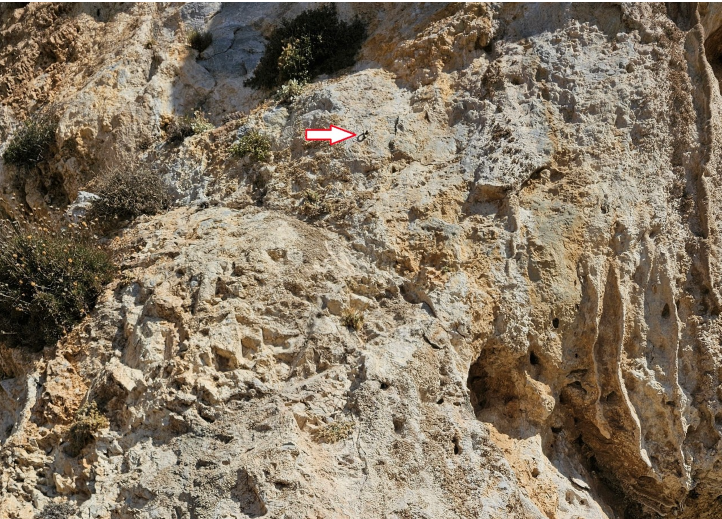
To my eyes there is nothing unusual to see here – just limestone with plenty of secondary deposition, as one would expect in an overhung location.
The failed bolt is illustrated below. This failure mode is what I like to call typical Western Mediterranean SRB Attack. Note I say Western, while of course Kalymnos is Eastern, yet just look at that “shiny outside but rotten inside” appearance typical of that we encounter at the sea cliffs of say the Balearic Islands, Sardinia or the Costa Blanca.
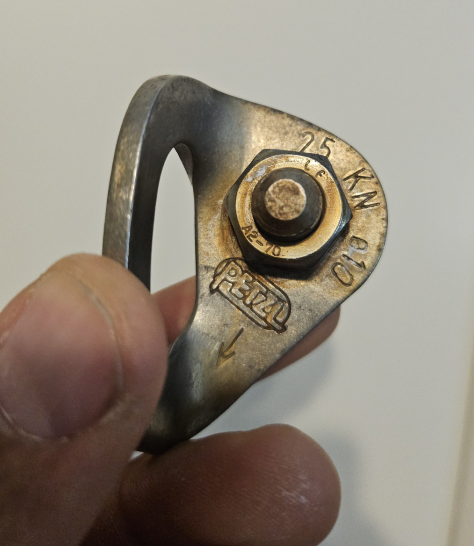
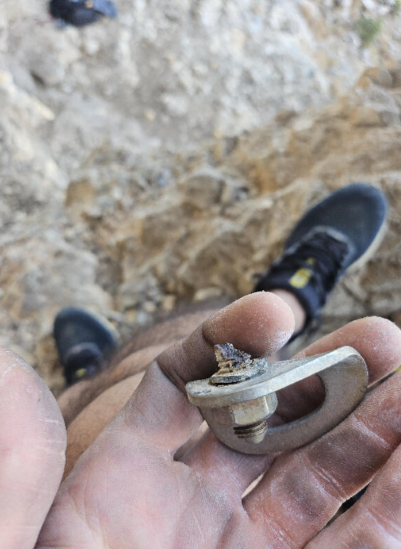
We’ll come back around to consider the Western Mediterranean. For now, let’s take a close look at what we have in front of us.
On closer examination:
OK, its not quite 304, but similar enough to potentially be a problem.
The nut is stamped A2, and the fixed hanger is almost certainly 304. Given it was the bolt that failed, not the nut or hanger, I have concentrated on the former. The bolt itself was analysed to give the composition below.
| composition (%) | analytical error | |
| Nickel | 8.5 | +/- 0.1 |
| Chromium | 17.0 | +/- 0.1 |
| Molybdenum | <0.5 | +/- 0.25 |
The chromium content is less than that I’d expect for the alloy 304. Looking instead at the possibility of 316, both nickel and molybdenum are well short of that required. So it’s neither 304 nor 316 but, as those of you who have been following my posts will know, I am suspicious of any alloy, not just 304, where the nickel content is less than 10%.
Experience shows that whilst low nickel content might be one factor, it is, of itself, not sufficient to sponsor the catastrophic bolt failure we witness on certain sea cliffs. The other requirement is that there needs be large levels of sulphate on the rock surface, or perhaps percolating through ground water, to act as an oxidant for sulphate reducing bacteria (SRB).
And it turns out that we do have solid evidence for environmental sulphate on Kalymnos, and thus 304 might well be a problem.
Some years ago we carried out limited wall-wash sampling at a number of Kalymnos crags and made two findings, a) sulphate levels were either problematical or insignificant but not in between, and b) proximity to the sea did not seem to be a factor. This is different to that we see in the Western Mediterranean, and later on I’ll elaborate on why I think this is so.
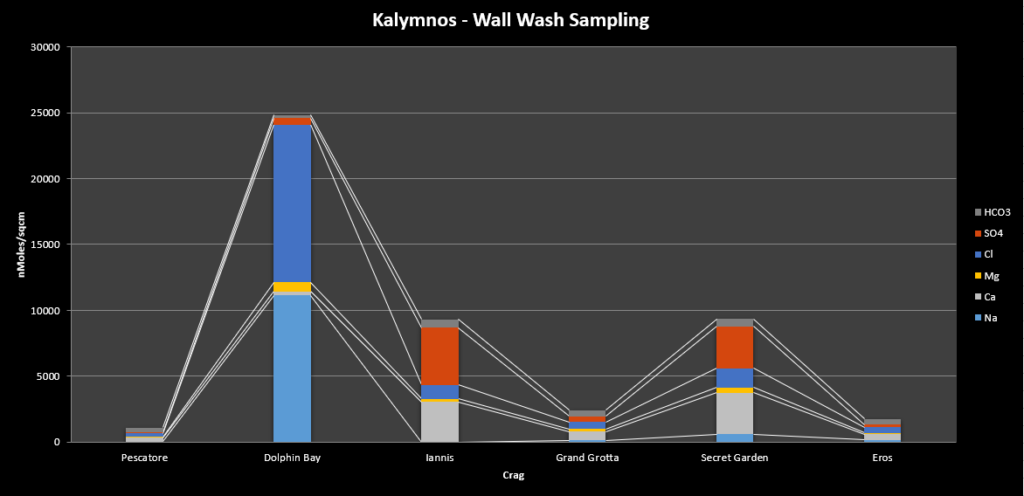
From these results we definitely can identify two sulphate crags on Kalymnos, and thus need to accept that a third at Ourania is a possibility.
If we look for evidence of SRB attack then we find it.
Whilst it would be nice to get a positive sulphate sample from Ourania, it is not necessary should we wish to pin the failure of this bolt on SRB attack. If SRB have been directly involved in removing significant amounts of metal, then there will be equivalently significant amounts of the metabolic product, iron sulphide, at the point of corrosion. Thus, should we make a positive identification of metal sulphide, then a biological agent has to be involved in the observed corrosion, and we can conclude that SSC(sulphide stress cracking) via microbial attack and not SCC (stress crack corrosion) is involved. For a more detailed discussion on how SRB plays into the SCC vs SSC debate refer to this post where I discuss data from Cabo da Roca.
Firstly, we get a positive response with the iodine-azide test.
The “go to” spot test for metallic sulphides is the classic Iodine-Azide test. In the picture below, I have scratched off a tiny fragment from the fracture surface and placed it under the microscope with a drop of the iodine-azide reagent. The progressive formation of bubbles of nitrogen gas is a sure indicator that we have found iron sulphide.
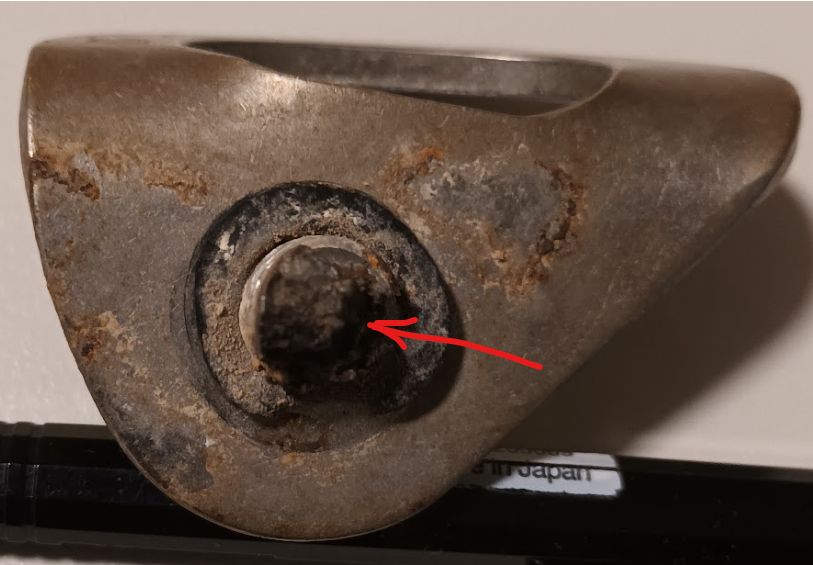
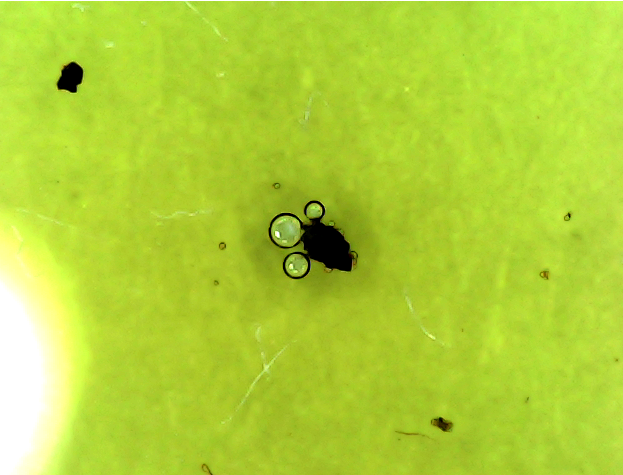
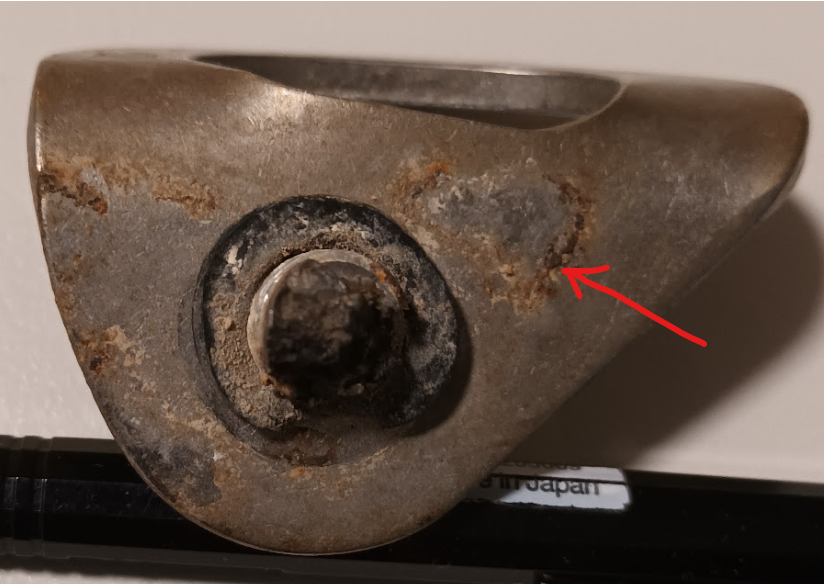
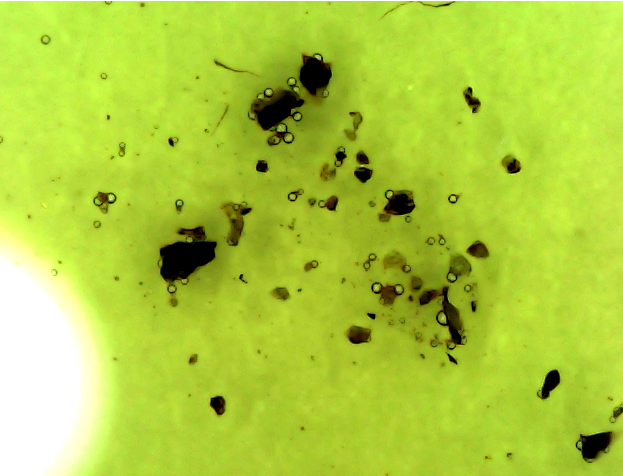
Although never active until they find themselves in a low oxygen environment, SRB are ubiquitous. These little guys will utilize any opportunity to attack steel, and so, in the picture below, note that they have started to attack the fixed hanger where it is pressed sufficiently close to the rock to reduce the oxygen level.
Secondly we find the metabolite greigite.
When a bolt has been under extensive attack by SRB, it is almost always possible to identify locations on the sample where the oxygen/pH profile has suited the precipitation of the iron sulphide, greigite (Fe3S4). This metabolite forms shiny, iridescent, octahedral crystals, and is easily recognized. The photo below shows such a grouping on our sample.
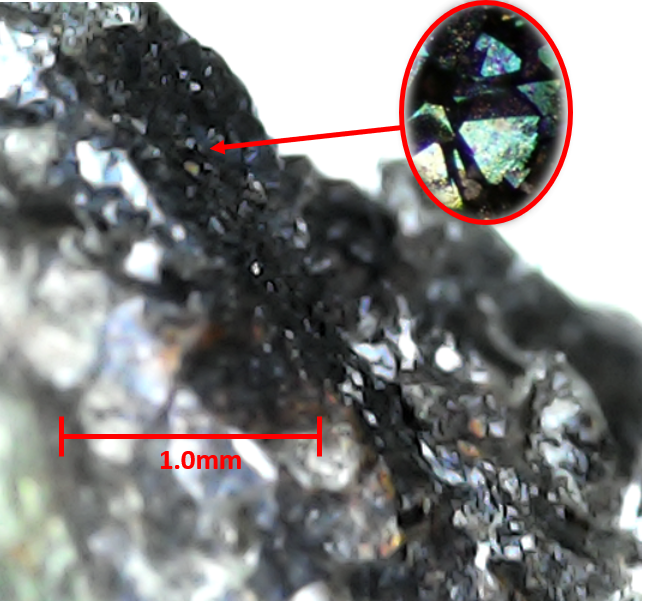
This finding, taken in conjunction with the positive iodine-azide response, confirms SRB activity.
Thirdly we find evidence of hydrogen embrittlement.
The final piece of evidence I look for is micro-cracking and fracturing on the sub-granular scale. It is a good indicator of the hydrogen embrittlement which accompanies SRB attack, and is the main enabler of stress cracking.
In the photograph below we see the fracture edge is highly fragmented with little regard to the grain boundaries. A close examination of the area arrowed shows extensive cracking and fragmentation of the metal on the 1um to 2um scale.
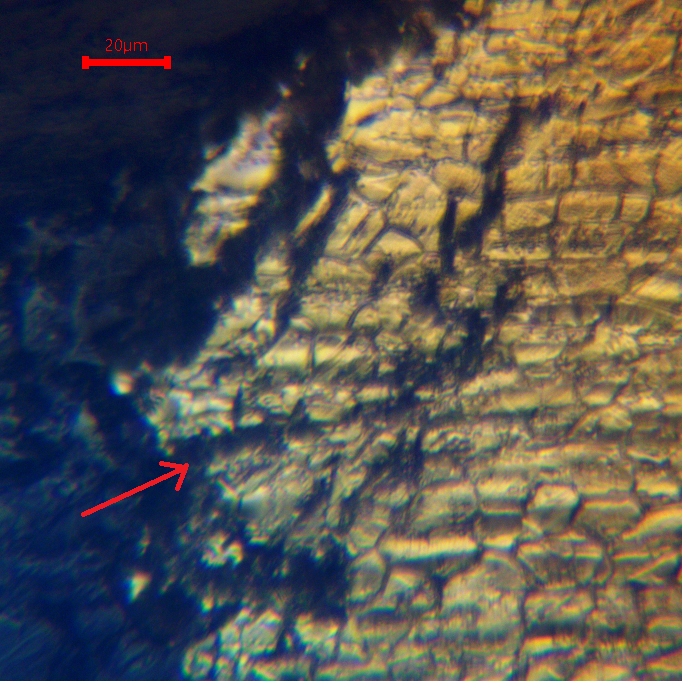
I never cease to be amazed by such images. How can such a tough, ductile material like 304 become so brittle as to be reduced to dust-sized pieces? For those interested, you can read more about this phenomenon it in this post where I discuss SRB attack on climbing anchors at Cabo da Roca.
So, do we have a problem here?
If instead we ask -“Does catastrophic SRB-mediated bolt failure occur on Kalymnos?”, surely the answer has to be yes. We’ve just demonstrated it at Ourania.
But, to the further question – “Is the occurrence widespread?” The answer, just as surely, has to be no. It cannot be widespread, or we would be looking at thousands of such failures, not the mere handful I currently know of. Yet, regardless of how rare it might be, the fact that the danger can be so completely hidden demands our attention.
Given what we know of the role of sulphate as the enabler of SRB attack, the problem comes down to understanding the factors controlling sulphate distribution. And therefore, as promised, let’s swing over to the Western Mediterranean to see what happens there.
Let’s compare the Western Mediterranean :
Well not quite so fast, let’s first understand that, world wide, as far as major, aggressively-corrosive locations for climbing anchors are concerned, there are just three locations that have acquired notoriety. One of them is the Western Mediterranean including the Portuguese Coast, while Railay/Tonsai in Thailand is the second, and Long Dong in Taiwan the third.
In all cases we find –
- The signature of SRB attack dominates the failure mode.
- Large (gram) amounts of sulphate are present.
- The corrosive environment is restricted to the immediate sea shore, and falls off in severity within half to one kilometer from the sea.
- The adjacent ocean overlies an active, volcanic, back-arc basin.
Let’s see how these general characteristics shape up for the Western Mediterranean. Be aware that the full story is long and convoluted, and you really need to consult this post to grasp the reasoning and the associated literature references. For now I’ll reduce it to dot points.
- The South Tyrrhenian Sea occupies the deep back-arc basin behind the islands of the Aeolian Volcanic Arc. The plate tectonics favour the subsea introduction of magmatic components such as elemental sulphur into the sea water.
- A current within the Western Mediterranean Deep Water sweeps the Tyrrhenian sea, and then circles both coasts of Sardinia, the Costa Blanca and both northern and southern coasts of the Balearic Isles. It finally exits along the bottom of the Gibraltar channel, only to turn sharply northward to track the entire coast of Portugal.
- Sea cliffs anywhere along its track exhibit high sulphate levels and sponsor SRB attack on stainless steel anchors.
- I hypothesize that elemental sulphur, being hydrophobic, ultimately becomes associated with the organic surface film of the ocean. From there, it is transported to the cliff environment by the spume fraction of the aerosol created at wave break. This portion of the marine aerosol is of large particle diameter and rapidly falls out of suspension within a short distance from the shoreline.
- We can anticipate that elemental sulphur, once deposited onto the thin soils of the cliff environment will be freely metabolised by sulphur oxidising bacteria (SOB) to yield sulphuric acid.
- Excess sulphate becomes somewhat immobilized as the sparingly soluble calcium salt and thus can accumulate from one volcanic episode to the next over millennia.
I have highlighted the key features of this proposal on the map below.
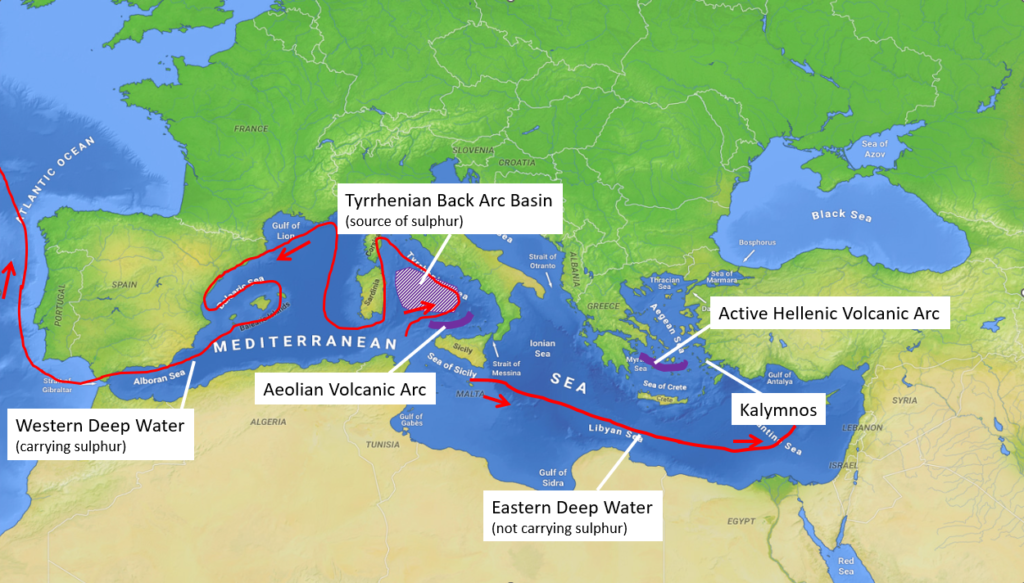
The Eastern Mediterranean basin is something quite different. It owes its depth to the subduction trench where the African continent is being pushed beneath the European continent. Unlike the situation for the Tyrrhenian basin where the mantel is all but exposed, this eastern basin presents the full crustal thickness plus a substantial depth of accretionary material. The exposure to magmatic components such as sulphur can be assumed to be non-existent.
It should be noted that there is some active volcanism in the eastern basin as presented by the Hellenic Volcanic Arc. And, yes, the Aegean Sea occupies a crustal, extensional basin behind it. However, there is no evidence of crustal thinning sufficient to induce the injection of new crust as we see in the West. If there were to be leakage of elemental sulphur into the sea, then we would expect to see sulphate, and thus SRB attack, at the sea level crags on Kalymnos, and this we do not.
Clearly, sulphur is present on some Kalymnian crags, but not others, so where does it come from?
Because we don’t find sulphate at say, Dolphin Bay, which is directly in the path of sea spray, yet have some occurrences at say, Iannis, which is set back and well up from the shore, this makes me think we need to be looking for a sulphur source other than marine elemental sulphur.
Given the close proximity of Kalymnos to the Hellenic Volcanic Arc, the possibility of the intrusion of water from a hydrothermal source cannot be discounted. Such waters often contain dissolved hydrogen sulphide, which, when exposed to the outside cliff environment, may be metabolised by SOB to sulphuric acid, which in turn could become sequestered on the limestone surface as calcium sulphate.
Black streaks running down the crag make me suspicious that there are sulphide containing hydrothermal water weeping from the cliff, but, without a thorough investigation of this phenomenon, I’m inclined not to put too much weight on this observation.
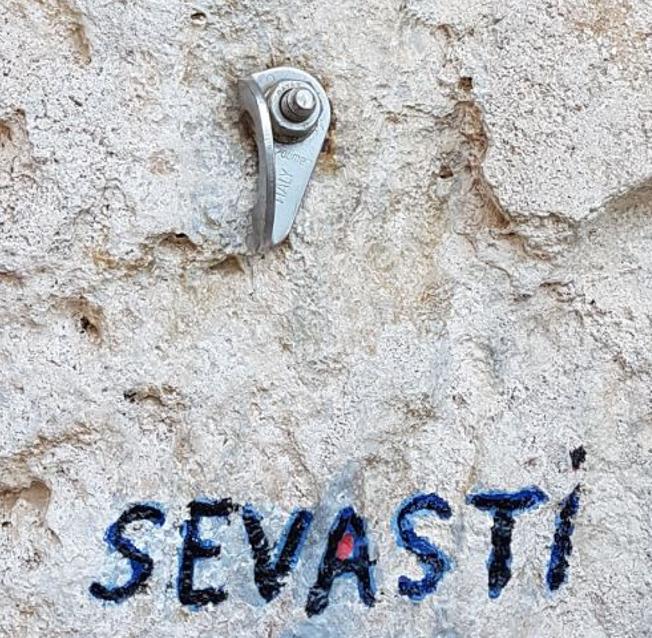
Our problem is that there is no visible clue to the fact we are dealing with a sulphate crag. The photo below is from sector Iannis, right at the base of Sevasti. Do you see the faint square within the red circle?
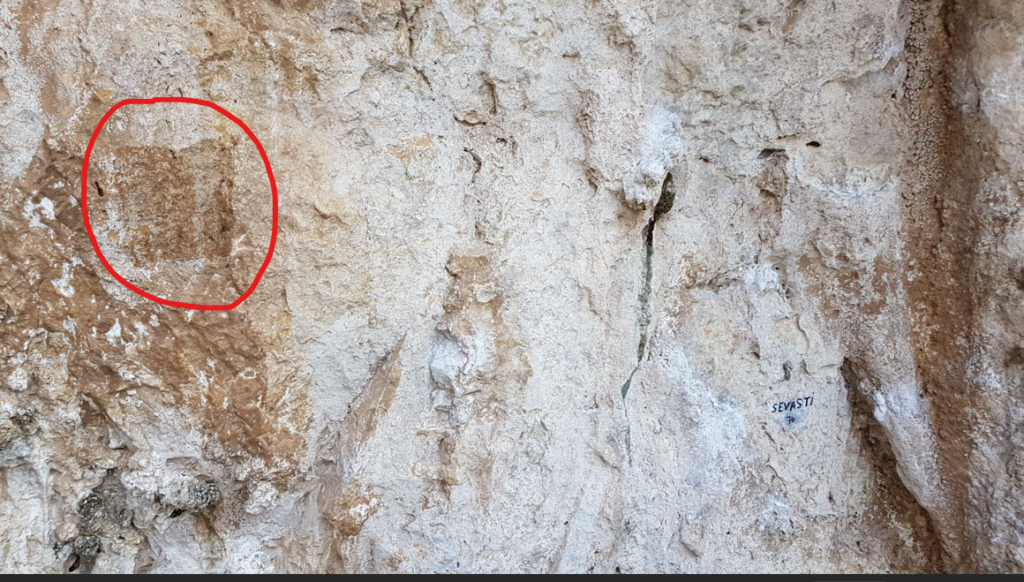
We took a sample from there and it revealed 4.3umoles/sq.cm of sulphate. The chloride concentration, presumably derived from the ocean, was much lower at 1.0umoles/sq.cm.
Experience indicates that this level of sulphate is a problem for 304 climbing anchors, yet, by eye, you would be none the wiser that there was a problem here.
Here is the first bolt. Hey, that looks great – lets go!
As you proceed up the climb, most bolts look fine, until you eventually come to the one illustrated below. Eeek! If you know what you are looking at here then you know. If you don’t, then it is time to understand that this bolt, and all the bolts below you might not even do so much as support your weight. This is the “black ring of death”, so named by John Byrne many years ago when he was describing the catastrophic bolt failure that was occurring on Cayman Brac.

In many ways, one should be thankful to encounter a clear example of the “black ring of death”. It is not always that SRB are considerate enough to flag their presence. As the example from Ourania tells us, they can be present without showing the slightest indication of the underlying corrosion.
There can be no doubt some Kalymnian crags will be impacted by sulphate. If the source of that sulphate is hydrothermal, as I conjecture, then it is difficult to see how we can know a good crag from a bad one.
What should we do?
Titanium is attractive:
If the cost of replacing thousands of bolts with titanium glue-ins was no problem, then yes, swapping over to titanium is attractive. Consider that a large number of titanium bolts have been giving excellent service in Tonsai/Railay for the past twenty years. This is a notorious SRB hotspot and is clear evidence that gr2 titanium seems to work.
Note that I use the phase “seems to work”. This is not because I doubt the evidence, but because I am painfully aware that I don’t understand the mechanism for such resistance. It is actually worse than that, my chemistry 101 tells me that titanium should be quite unsuited to the reducing conditions that prevail just below the surface of the bolt hole. I hate having to extrapolate from ignorance like this, but knowing that it “seems to work” definitely outshines alternatives that “clearly don’t work”.
Is 316 the answer?
Year on year, the evidence builds that true 316 is resistant to SRB attack. However, in my opinion, the jury is still out on this one. Our problem is that, historically, there has been a persistent problem of low quality ( low nickel) 316 entering the supply chain, making it very difficulty to judge the corrosion resistance or otherwise of bolts installed say 20 years ago.
We have evidence from the UIAA sponsored test sites in Railay/Tonsai, now coming into their 10th year. Simply based on observation, I assess 304 anchors to be in dire trouble, 316 to be pretty good, but definitely showing some superficial signs of corrosion, while titanium and the super-austenitics look as good as new. Make of that what you will. It is still early days, and the final destructive analysis must wait another ten years.
In practical terms, surely it is a no-brainer to use 316 on Kalymnos when deterred by the cost of titanium. The only caveat I would add is to reject any steel that is at all magnetic. This is the simplest test for low nickel content. I’m still being surprised by the amount of substandard 316 I am finding.
What if we identify the sulphate crags?
As I have already pointed out, I don’t believe there are many sulphate crags on Kalymnos. If we were to identify these, then surely the community could run to re-bolting them in titanium? Think of how successful the titanium re-bolting efforts has been in Railay/Tonsai. Surely there are the folks out there that could make this happen at Kalymnos?
Identifying sulphate crags is both quick and easy using a simple and cheap test kit. Illustrate below is a test kit I made up to trial the idea with UIAA Safe Com.

It takes just a few minutes to get a result like the positive one shown below. Those few minutes are not much given the value of the warning this test issues.
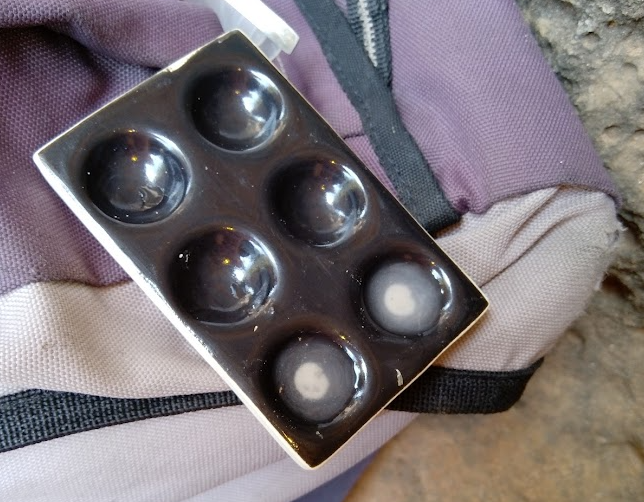
I would happily supply such kits for little more than the cost of postage, but for the fact conventional carriers throw up their hands in horror at the possibility of it containing “chemicals”. However, there is nothing special about the reagents, so I can help folk with advice if they want to make a kit up locally.
Discover more from Crag Chemistry
Subscribe to get the latest posts sent to your email.
14 replies on “SRB Mediated Bolt Failure Confirmed at Ourania”
Thanks again David, for this new report.
As a interesting coincidente,most of the retired 304 hangers from Menorca, show this dark brown rust Mark, in the same spot at the back side of the hanger,that you have pointed out with the red arrow.
Yes, I’ve seen other examples of SRB attack at that point on the fixed hanger. I believe that once you have sufficient sulphate in contact with 304, all you need is a mechanism to lower the oxygen level and the bacteria switch on their sulphate reduction metabolism.
This raises the interesting question as to where do the bacteria come from. I think we have to conclude that they are ubiquitous and can survive, but not flourish, in the presence of oxygen.
Hi Dave. Thank you again for a great post about your findings. I was notified about this post just a couple of hours after being forwarded the 2025 UIAA/DAV Bolting Guide. It is impressive that this report ignores completely SSC. In fact, SSC appears once in the report as a typo :-). Cheers.
Ah yes, I noted that. 🙂 But that’s ok. One of the beauties of science is that it is eventually self-correcting. Time will tell whether I’m right or not.
However, the new guide is impressive in its detail. UIAA/DAV are to be congratulated in seeing this project through.
Thanks for such an informative and thorough post, Dave! I was in Kalymnos last September so definitely spooky to read about the bolt failure then. For the average sport climber with no tools or kits, would you recommend knocking on every bolt you arrive at with a carabiner and/or yanking on it a little after clipping as a good practical thing to do?
If you know you are at a sulphate crag, then I would trust nothing in stainless steel. Maybe testing with a strong magnet would provide a layer of insurance but I don’t think we are at a point where we can be sure about that. The last time I was at Tonsai/Railay I simply knew too much and kept to the titanium bolted climbs.
If you are at a crag, not a known sulphate crag, but one where the possibility exists, eg Kalymnos, then it is worth looking carefully for dark corrosion products around the bolt/washer/nut or glue/metal junction. So yeah, you can try giving a bolt a sharp tug, but really, what is the point? Once you know what you know, it is hard to relax and feel safe. It would be more practical to be really vigilant with redundancy. Luckily, Kalymnos bolting practice tends toward low first and second bolts.
Can you point me to the sampling and analytical protocols/instruments you use to determine sulphate levels?
Hi Max, the information sheet that went with the trial sulphate spot test can be found here –
https://cragchemistry.com/wp-content/uploads/2020/04/UIAA-Sulphate-Sample-Kit.pdf
It gives the concentrations of the reagents. Note that there is nothing at all critical about the concentrations. Note also that whilst testing of a piece of solid efflorescence is good, as illustrated, it is also possible to swab down a section of wall with wet cotton wool, and squeeze that out into the test plate.
If you want details of my quantitative laboratory method for wall-wash samples, it is described here –
https://cragchemistry.com/determination-of-sulphate/
Thanks for an excellent post. I was at Ourania just after the incident, inspecting the lower parts of the route and taking some photos, wondering what was the mechanism behind the bolt failure. Now I feel a little bit wiser.
I hope you don’t end up haunted by this failure. That bolt looks absolutely perfect doesn’t it? Fortunately this is not magic, and we have a rational explanation and solution.
Given the amount of sub-standard 316 you’re finding, I think it would be worth testing bolts from various well-known sources in order to find out if it’s specific to one manufacturer / batch. If manufacturers aren’t taken to task nothing will improve!
I hear you, mate, but what to do about it? The UIAA Safe Com are aware of the problem, and I’m confident will continue tightening the UIAA123 standard. But what then? A standard is one thing, compliance across international borders is quite another.
Much blame can be attributed to the “dirt-bag” traditions of the climbing community. This tradition translates poorly to the professionalism required for safety engineering, yet that is what we have to do. Route equippers need to step up to the challenge of being professionals, and to be fair, we have seen many taking up this challenge in recent years.
There are simple tests route equippers could be doing when they buy in a big batch of anchors for a project. For example if you buy in 316 components and they are obviously magnetic, send them back to the manufacturer. Don’t install them in the cliff because you are all fired up to go, and too impatient to get things done right.
Titanium is very expensive ! and not sure how it will be in 20 years !
What do you think from Bolts in 316 TI , diameter 12 mm ?
Andre
Note that I’m talking in the context of bolting a known sulphate cliff. Knowing what we now know of such environments, I would argue that titanium may well be the lowest cost.
This is because, if you want to substitute 316 stainless steel, you have to first verify that the “316” you buy is in fact the real thing. Much of that you can purchase off the shelf is inferior and will be risky in a sulphate environment. So what are you going to do? XRF every bolt before you install it? And even then you wouldn’t detect a high sulphur variant for instance.
All bolts, regardless of type, will expose hazards due to poor manufacturing control. What I’m talking about here is the additional hazard presented by sulphate reducing bacteria. As things currently stand, the surest way to neutralize this specific additional risk is to use titanium bolts.